How to Rank in Google AI Overviews: What We Can Verify
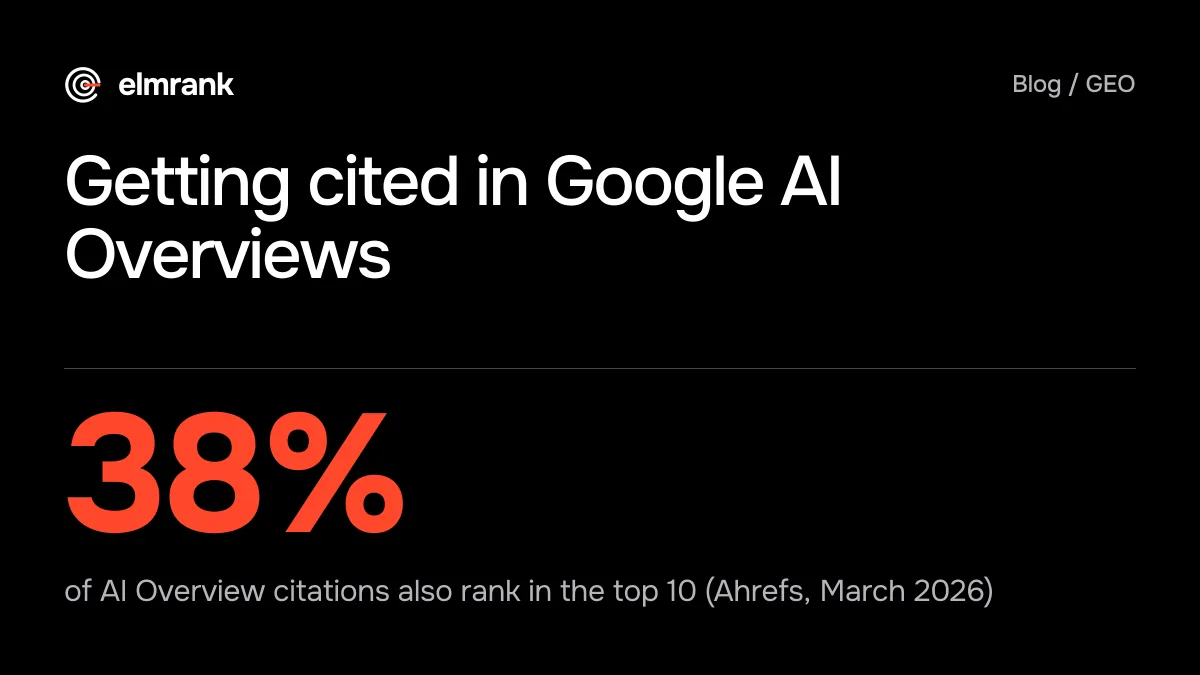
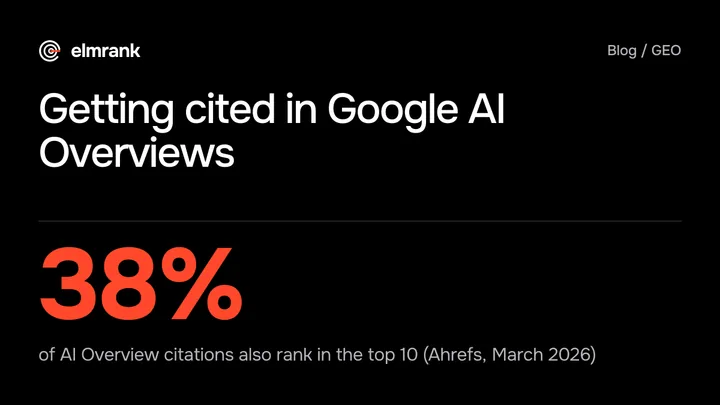
In Ahrefs' 2026 data, 38% of AI Overview citations also rank in Google's top 10. What Google says gets a page cited, what blocks it, and how to measure it.

By Tyler Phan6 min readLast reviewed
Part of our guide to AI search and GEO
On this page
In an October r/SEO thread about explaining AI Overview traffic drops to clients, the second most upvoted reply, at 11 points when we read it, came from someone who had been an expert witness. A company had sued its web developer over a traffic drop. "Turned out that the drop was actually Google implementing AI Overviews in the SERPs," they wrote. "The site still had #1 rankings in organic after a redesign of the site and the rankings went up. But traffic went down because of the AI Overviews."
You can't remove the overview from someone else's search. What you can work on is whether your page is one of the links inside it.
What Google says decides it
Google's guide to AI features is short on levers. "You can apply the same foundational SEO best practices for AI features as you do for Google Search overall." It adds two facts that matter for planning. First, the overviews don't show on every search: "AI Overviews are only shown when our systems determine that it is additive to classic Search, and as such, often don't trigger." Second, they don't stop at your query. Google says both AI Overviews and AI Mode "may use a 'query fan-out' technique," which it describes as "issuing multiple related searches across subtopics and data sources," to build the answer.
- 1Indexed, with a snippet allowedGoogle's only technical requirement
- 2Found for the search or a related oneQuery fan-out may run searches across subtopics
- 3Shown as a supporting linkOnly on searches where an overview triggers
- 4Counted in Search ConsoleGenerative AI report: impressions
So the work is ordinary SEO aimed one step wider than usual. Google doesn't say how many related searches a fan-out runs or which ones. A page, or a set of linked pages, that also answers the questions a reader asks next has more ways in.
We'd ignore anyone selling a special format for this. Google's list of what it wants is the same list it gives for Search: crawling allowed "in robots.txt, and by any CDN or hosting infrastructure", internal links, a good page experience, "important content is available in textual form", structured data that "matches the visible text on the page", and up-to-date Merchant Center and Business Profile information. It also says "You don't need to create new machine readable files, AI text files, or markup to appear in these features."
What the ranking data says
Ahrefs has measured twice how often AI Overview citations come from the regular results. In July 2025 it studied 1.9 million citations from 1 million overviews, "analyzing the top 3 most visible citations in each response," and found that 76% of them ranked in the top 10 for the same search. Its March 2026 update covered 863,000 keyword results pages and "a grand total of 4M AI Overview URLs," and found a lower share (the two studies didn't count the same way; see the caveats below):
| Where the cited page ranked for the same search | Share of AI Overview citations |
|---|---|
| Top 10 regular results | 37.1% |
| Positions 11 to 100 | 26.2% |
| Not in the top 100 | 36.7% |
That's the blue-links-only count; counting every block on the page, including ads and other features, the top 10 share was 37.9%. The study's author, Louise Linehan, compares it with the 2025 figure and writes: "To me, that suggests AI Overviews are relying less on the direct search results and more on the sources showing up in fan out query SERPs." Ahrefs notes that Gemini 3 has powered the overviews since January 2026 and adds: "So, with the arrival of Gemini 3, it may be that fan out queries are playing a bigger role in source selection." It also found that YouTube made up 18.2% of the cited pages that didn't rank in the top 100, and 5.6% of all cited URLs.
Three caveats. The data comes from Brand Radar, Ahrefs' own AI visibility tool, so Ahrefs has a stake in the topic. A citation share isn't a cause: the study shows where cited pages ranked, not why they were picked. And the drop from 76% to 38% isn't like for like. The 2025 study looked at the top three citations in each overview; the 2026 one counted 4 million cited URLs, and between the two Ahrefs "improved our parsing methodology in Ahrefs, so that we can see even more of the citations that appear in AI Overviews." The lower citations the first study left out may also rank lower, so part of the drop may be a difference in counting.
What we take from it is narrow. In the 2026 data, ranking in the top 10 for your main search accounts for barely more than a third of AI Overview citations, and Ahrefs' best explanation for most of the rest is the related searches.
Five things to check on your own pages
- No nosnippet, data-nosnippet, max-snippet or noindex on pages you want cited; Google lists all four as controls that limit what Search shows
- Googlebot allowed in robots.txt and by your CDN or hosting; Google says robots.txt rules for Googlebot are the control for AI features in Search
- Each page answers its main question near the top, in text, and links to the pages that answer the next questions
- Structured data matches what's visible on the page
- For shops and local businesses, Merchant Center and Business Profile details are current
The first item is the one we'd check today, because one line in a shared template, such as <meta name="robots" content="nosnippet"> in the site's layout, puts the control on every page. If you want out of the overviews on purpose, the same controls are Google's answer. Its guide sends Google-Extended, the robots.txt token people often reach for, to "AI training and grounding in some of Google's other systems," not to Search.
How to see whether it's working
Search Console has a generative AI performance report, and Google's note on its help page reads: "As of August 31, 2026, we've rolled out these insights to all websites worldwide." It counts impressions, which it defines as "how many times links to your site were shown to a user in a generative AI feature on Google Search," for AI Overviews and AI Mode, by page, country, device and date. If you can't see it, Google says that "usually happens when your site hasn't received enough impressions in generative AI features on Google Search."
Clicks are harder. Google says sites in AI features "are included in the overall search traffic in Search Console," inside the Performance report's "Web" search type, so AI Overview clicks sit inside your normal totals. We checked whether the Search Console API can separate them. On October 17 we asked it for search appearance types over the 30 days to October 14 on our three sites: none returned an AI Overview type, and the types that did come back were review snippets, product snippets and translated results. Our sites' numbers come through that API, which is why we don't have AI Overview figures for them to show you.
For a traffic drop, the most useful method we've seen came from another reply in the same thread, at 3 points: "split the informational queries into ones with an AI Overview and ones without. if only the overview ones lost clicks, the client believes it. if both dropped, it's a ranking problem and Google was never the story." You have to check by hand which of your queries show an overview, but it turns a guess into a comparison.
Where we fit
For Google, AI Overviews and SEO are the same work, so we don't sell them separately. Our post on SEO vs GEO for a small business covers what that means for a budget. On our plan, the first month ($500) includes an SEO and GEO audit and the technical fixes it finds, crawler access included, plus site design and a content plan. From month two, $300 a month pays for up to 30 articles written to answer questions directly, ongoing fixes, hosting and a monthly report with your Search Console numbers. Our sample report shows one for a site we run.
We don't promise AI Overview citations, and our terms say so. The AI search optimization page lists what we set up and what we report.
Questions
Does blocking Google-Extended keep my site out of AI Overviews?
Not according to Google. Its guide says robots.txt rules for Googlebot are the control for how a site is crawled for Search, AI features included, and points to Google-Extended only for limiting 'AI training and grounding in some of Google's other systems.' To limit what Search shows from a page, Google lists nosnippet, data-nosnippet, max-snippet and noindex.
Can I see AI Overview clicks in Search Console?
Not as a separate number. Google says clicks and impressions from AI Overviews and AI Mode are part of the Performance report's Web search type. The generative AI performance report, open to all sites since August 31, 2026, shows impressions in those features, by page, country, device and date.
How we know this
Written by Tyler Phan. Every source below was read on the date shown; the page was last reviewed on Oct 28, 2026.
- Google Search Central, AI features and your website, accessed Oct 17, 2026
- Search Console Help, Generative AI performance report (Search), accessed Oct 17, 2026
- Ahrefs (Louise Linehan, Xibeijia Guan), Update: 38% of AI Overview Citations Pull From The Top 10 (March 2, 2026), accessed Oct 17, 2026
- Ahrefs (Louise Linehan), 76% of AI Overview Citations Pull From the Top 10 (July 21, 2025), accessed Oct 17, 2026
- r/SEO, How do you explain to clients that traffic dropped because of AI Overviews? (comments by u/billhartzer, u/marintkael), accessed Oct 17, 2026
Send us your site.
We reply within 12 hours with what we'd fix first. Then we run it for you, technical SEO and content: $500 for the first month, then $300 a month for up to 30 articles. You don't need any technical knowledge, and you can cancel any time.