What Is Generative Engine Optimization? What Our Logs Show
What is generative engine optimization? Where the term came from, what Google and OpenAI say it takes, and how many visits AI assistants sent our sites.

By Tyler Phan8 min readLast reviewed
On this page
Generative engine optimization (GEO) is the work of getting your pages found, used and linked in answers written by AI: ChatGPT, Perplexity, Gemini, Copilot, Claude, and Google's AI Overviews and AI Mode. The name comes from a 2023 research paper, "GEO: Generative Engine Optimization," by Pranjal Aggarwal and five co-authors, later accepted to KDD 2024. It starts from the site owner's problem: "content creators have little to no control over when and how their content is displayed."
Google's answer to the question is short. Its guide to generative AI search says: "From Google Search's perspective, optimizing for generative AI search is optimizing for the search experience, and thus still SEO."
We run three content sites and elmrank.com on one server, so we see both ends: the AI crawlers reading our pages and the visits AI assistants send back. This guide puts what the AI companies document next to what our server log and Google Analytics recorded, and links to the posts that cover each part in detail.
Where the term comes from
The 2023 paper treated ChatGPT-style search as a new kind of search engine, one that writes an answer from several sources instead of listing links. The authors built a benchmark of queries from many fields, which they called GEO-bench, and tested changes to the source pages. They reported that such changes could "boost visibility by up to 40% in generative engine responses," and that what worked "varies across domains." That was a lab result on their own benchmark. It doesn't tell you what will happen to your site in ChatGPT next month.
Since then GEO, and its cousin AEO (answer engine optimization), have become names for a service. Google's guide describes both as terms "used to describe work specifically focused on improving visibility in AI search experiences," and asks anyone considering "third-party 'AEO' or 'GEO' advice or services" to check it against Google's own guidance. Prices for that service run from about $199 to five figures a month, as our post on what generative engine optimization costs shows.
What Google says it takes
Google's AI Overviews and AI Mode are built on its search index. Its guide says they rely on "our core Search ranking systems to retrieve relevant, up-to-date web pages from our Search index," and may use "query fan-out," running related searches across subtopics before writing the answer. A page has to be "indexed and eligible to be shown in Google Search with a snippet." Since August 31, 2026, Search Console also has a setting for this under Settings, Search generative AI: Google says it lets you "manage your site's inclusion" in AI Overviews, AI Mode and generative AI features in Discover.
The guide also has a list of things you can skip for Google. Among them: "You don't need to create new machine readable files, AI text files, markup, or Markdown to appear in Google Search," there's "no requirement to break your content into tiny pieces," and "Structured data isn't required for generative AI search." What it asks for instead is "non-commodity content," such as a first-hand account, over summaries of what's already online.
Google counts AI Overviews and AI Mode in the Performance report "within the 'Web' search type," together with ordinary results, and offers a separate Generative AI performance report for impressions. In the Search Console API we pull our numbers from, the search appearance types returned for our three sites included none for AI Overviews, so our click data can't tell the two apart. How to rank in Google AI Overviews covers what gets a page cited there, and SEO vs GEO for a small business covers what that means for a budget.
What the other AI assistants need
ChatGPT, Perplexity and Claude run crawlers of their own, and those crawlers have to be let in. OpenAI's help page on searching the web with ChatGPT says: "To make a website eligible for inclusion, allow OAI-Searchbot to crawl the site and confirm that the website host or content delivery network allows traffic from OpenAI's published searchbot IP addresses." Perplexity says PerplexityBot "is designed to surface and link websites in search results on Perplexity." A robots.txt rule or a firewall setting that blocks those crawlers can keep you out of those answers, however good the page is. Not entirely, in ChatGPT's case: OpenAI's crawler page says sites that block OAI-SearchBot "will not be shown in ChatGPT search answers, though can still appear as navigational links." ChatGPT not citing your website and how to get cited by Perplexity go through the checks, and how to get mentioned in ChatGPT covers the other places ChatGPT looks, such as partner search providers and product feeds.
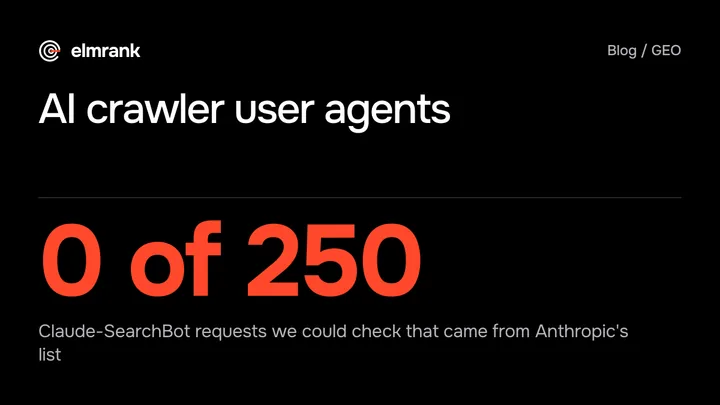
Most AI companies run several bots: one that collects training data, one that builds a search index and one that fetches a page while a user waits. They follow different rules, and OpenAI says its settings are independent, so blocking its training crawler doesn't remove you from ChatGPT search. Our list of AI crawler user agents names each one, and should you block AI crawlers has the choice for a business site.
What our logs show
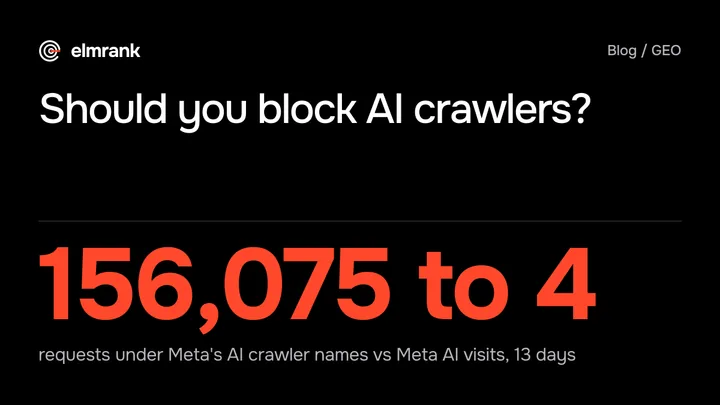
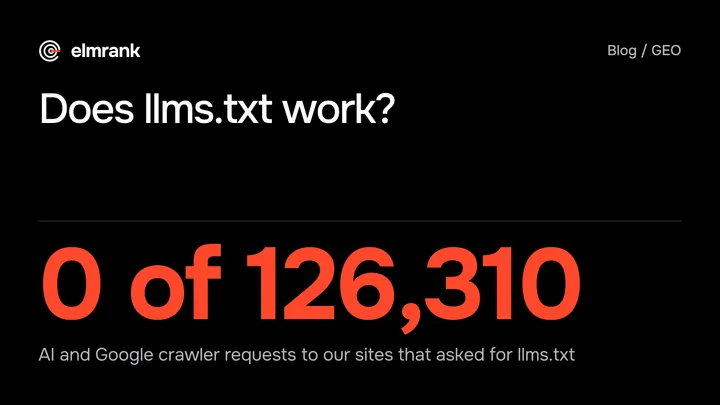
Our server runs elmrank.com, the three sites on our use cases page and four other sites of ours. From October 6 to 18, 2026, crawlers under the names of six AI companies made 271,470 requests to it, 10.2% of all the requests it answered. Very few visits came back for that. On the seven days when ChatGPT's links were tagged normally, OpenAI's crawlers made about 115 requests for every visit ChatGPT sent; Meta's AI crawlers made 156,075 requests and Meta AI sent 4 visits. Those visits were counted across all eight sites, so they're a different set of data from the three-site table below. In 14 days, crawlers from OpenAI, Anthropic, Perplexity and Google never asked for llms.txt, as does llms.txt work shows.
The visits are the part a business cares about, so we pulled Google Analytics for our three content sites from their launch to October 19, 2026. We counted a visit as coming from an AI assistant when its source named ChatGPT, Gemini, Copilot, Perplexity, Claude or Meta AI.
| Month (2026) | Google organic visits | AI assistant visits | AI visits per 100 from Google |
|---|---|---|---|
| April | 927 | 14 | 1.5 |
| May | 5,815 | 134 | 2.3 |
| June | 22,002 | 569 | 2.6 |
| July | 42,775 | 1,090 | 2.5 |
| August | 56,127 | 1,321 | 2.4 |
| September | 48,290 | 1,019 | 2.1 |
| October 1 to 19 | 26,930 | 520 | 1.9 |
GA4 sessions, three sites combined. Google organic includes clicks from AI Overviews and AI Mode, which GA4 can't separate.
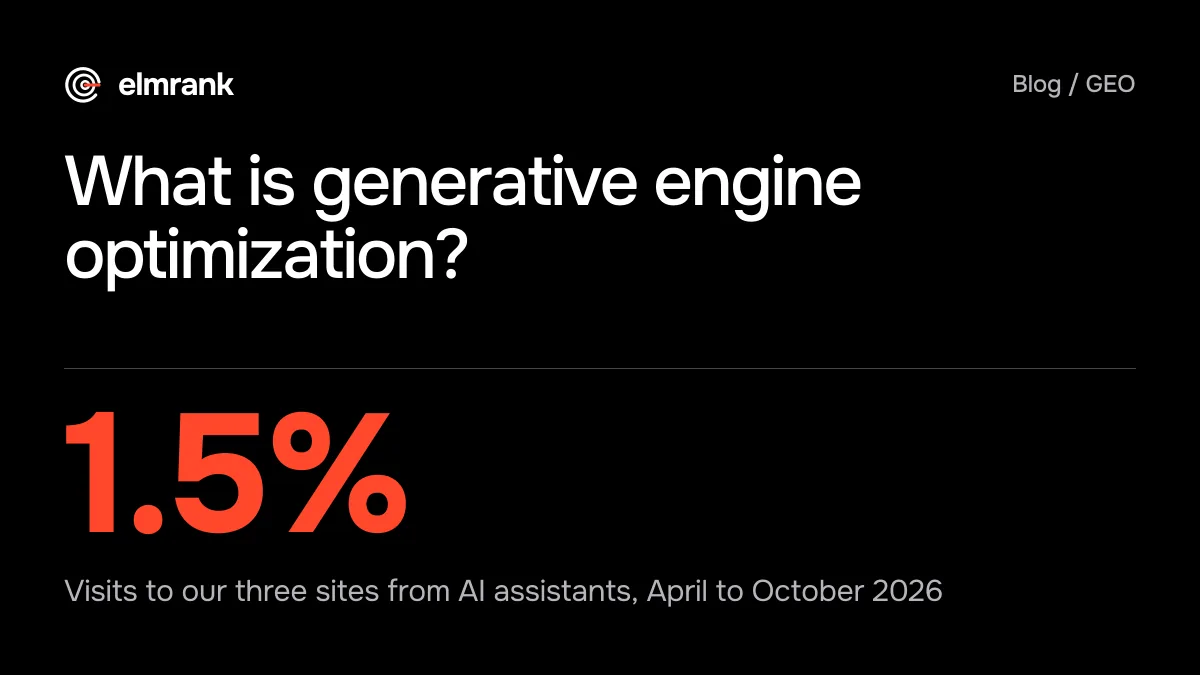
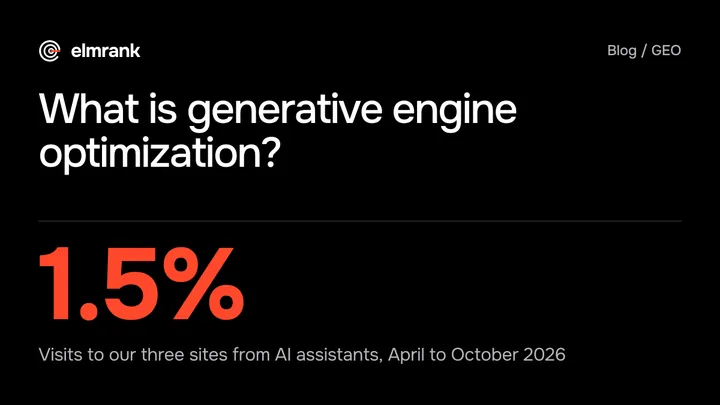
Over the whole period that came to 4,667 AI assistant visits out of 317,920, or 1.5%, against 202,866 from Google's organic results. ChatGPT sent 4,060 of them, 87%. Gemini sent 230, Copilot 189, Perplexity 100, Claude 81 and Meta AI 7. The ratio to Google barely moved as the sites grew: between 2.1 and 2.6 AI visits per 100 from Google in every full month from May to September.
Those visitors also behaved differently. GA4 counted 51% of AI assistant visits as engaged, against 67% of visits from Google organic, and their visits averaged 24 seconds of engagement time, against 48. They did open more pages, 1.42 per visit against 1.16. Google's guide says its own AI features reach people "who may be more inclined to engage with your site, spend more time with your content." We can't test that for Google, because those clicks sit inside Google organic. For the other assistants, our numbers went the other way. Our guess is that someone who already has the answer clicks through to check a detail and leaves, but GA4 can't tell us why.
These numbers come from three entertainment sites, not from businesses selling a service. GA4 misses visitors who block its tag or decline cookies, and from about October 9 to 14 most ChatGPT links arrived with no tag or referrer, so October's AI count is low; tracking ChatGPT traffic in GA4 explains that gap. October 9 is also the day we set up Consent Mode on the three sites, and from then on GA4 recorded fewer visits from Europe's consent countries, so both counts in the October row are short. We measured that loss for Google visits in Search Console vs Google Analytics, not for AI assistant visits, so we can't say which way it moves October's ratio. And no assistant tells site owners how often it names a site without a click, so visits are all we can count.
How we'd approach GEO
- 1Let the crawlers inrobots.txt, CDN and firewall rules for OAI-SearchBot, PerplexityBot, Claude-SearchBot, Googlebot, Bingbot
- 2Get indexedPages in Google's index with a snippet; the same checks as SEO
- 3Answer in plain textThe answer near the top, with your own numbers or experience
- 4MeasureGenerative AI report in Search Console, AI Assistant channel in GA4, crawlers in the server log
Start with access, because it's the one step where GEO differs from SEO and the one you can check today. Then the index: a page that isn't indexed can't appear in AI Overviews, and why your website isn't showing on Google covers the usual causes. Then the page itself. Put the answer near the top, in words a person would use, and add what only you know: your prices, your numbers, what happened when you tried it. Google's guide asks for exactly that, and it's what we try to do in posts like this one.
Then measure what you can and stop there. Search Console's Generative AI report, the AI Assistant channel in GA4 and your server log are real numbers. A tool that claims to know your "share" of AI answers is sampling answers that change from one person and one day to the next. We wouldn't rewrite pages "for AI," split them into chunks or add special files; Google lists each of those as something you don't need.
Where GEO sits in our plan
We don't sell GEO as a separate retainer. Crawler access, indexing and pages written to answer a question are part of our AI search optimization work, in the same plan as the SEO: $500 for the first month and $300 a month after. The monthly report shows Search Console clicks and impressions next to AI referral visits. To see what we'd fix first on your site, send it to us: the list is free, and we reply within 12 hours.
Every guide in this series
- AI Crawler User Agents: The List, Checked in Our Logs
AI crawler user agents from OpenAI, Anthropic, Perplexity, Meta, Google, Apple and Amazon: what each is for, if it reads robots.txt, and what our log saw.
- Should You Block AI Crawlers? What They Took and Sent Back
Should you block AI crawlers? Requests under Meta's crawler names hit our sites 156,075 times in 13 days; Meta AI sent 4 visits. What we'd block or keep.
- Does llms.txt Work? 14 Days of Our Server Logs
OpenAI, Anthropic, Perplexity and Google crawlers made 126,310 requests to our sites in 14 days and never asked for llms.txt. Who did, and when to bother.
- How to Get Cited by Perplexity: Its Rules and Our Data
How to get cited by Perplexity: what its crawlers need, where its citations come from, and where GA4 filed the 46 Perplexity visits to our three sites.
- How to Track ChatGPT Traffic in Google Analytics 4
Where GA4 shows ChatGPT visits, what it needs to label them, and what we think happened when our ChatGPT sessions fell from 28 a day to 4.5 for six days.
- How to Rank in Google AI Overviews: What We Can Verify
In Ahrefs' 2026 data, 38% of AI Overview citations also rank in Google's top 10. What Google says gets a page cited, what blocks it, and how to measure it.
- How to Get Mentioned in ChatGPT: What's Documented
Where ChatGPT finds businesses to name: its crawler, search partners, listings, product feeds. What OpenAI, Google and Bing publish, and what studies found.
- ChatGPT Not Citing Your Website? What OpenAI Says
Why ChatGPT may not cite your site: blocked crawlers, CDN rules, weak pages. What OpenAI's own docs say, five checks you can run today, and what we track.
- SEO vs GEO: What Should a Small Business Pay For?
Google says AI Overviews need no special optimization beyond SEO. What that means for your budget, what to measure, and where GEO money gets wasted.
Questions
Is GEO different from SEO?
For Google's AI Overviews and AI Mode, no. Google says "optimizing for generative AI search is optimizing for the search experience, and thus still SEO," and that there are no extra requirements to appear in them. ChatGPT, Perplexity and Claude run their own crawlers, so GEO adds a step SEO doesn't need: making sure those crawlers can reach your pages. The rest is the same work, pages that answer a question well.
Do I need an llms.txt file for GEO?
Not for Google, which says it ignores the file. On our server, crawlers from OpenAI, Anthropic, Perplexity and Google made 126,310 requests in 14 days and none asked for llms.txt. Keep one if your platform makes it, but don't expect it to change what AI answers say about you.
How do I know if AI assistants send me traffic?
In GA4, open Traffic acquisition and look at the AI Assistant channel, or filter session source for chatgpt, perplexity, gemini, copilot and claude; some visits land in Unassigned or Referral instead. For Google's AI Overviews and AI Mode, use the Generative AI performance report in Search Console. Clicks from those features arrive in GA4 as google / organic, mixed with ordinary search.
How we know this
Written by Tyler Phan. Every source below was read on the date shown; the page was last reviewed on Oct 29, 2026.
- Aggarwal et al., GEO: Generative Engine Optimization (arXiv 2311.09735, accepted to KDD 2024), accessed Oct 22, 2026
- Google Search Central, Optimizing your website for generative AI features on Google Search (last updated July 10, 2026), accessed Oct 22, 2026
- Google Search Central, AI features and your website, accessed Oct 22, 2026
- Search Console Help, Search generative AI control, accessed Oct 22, 2026
- Search Console Help, Generative AI performance report (Search), accessed Oct 22, 2026
- OpenAI, Overview of OpenAI Crawlers, accessed Oct 22, 2026
- OpenAI Help Center, Searching the web with ChatGPT, accessed Oct 22, 2026
- Perplexity, Perplexity Crawlers (PerplexityBot and Perplexity-User), accessed Oct 22, 2026
- Elmrank, GA4 sessions by month and source for the three sites we run, April 1 to October 19, 2026 (pulled October 22, 2026), and our server's access log, October 6 to 18, 2026, accessed Oct 22, 2026
Send us your site.
We reply within 12 hours with what we'd fix first. Then we run it for you, technical SEO and content: $500 for the first month, then $300 a month for up to 30 articles. You don't need any technical knowledge, and you can cancel any time.