How to Track ChatGPT Traffic in Google Analytics 4
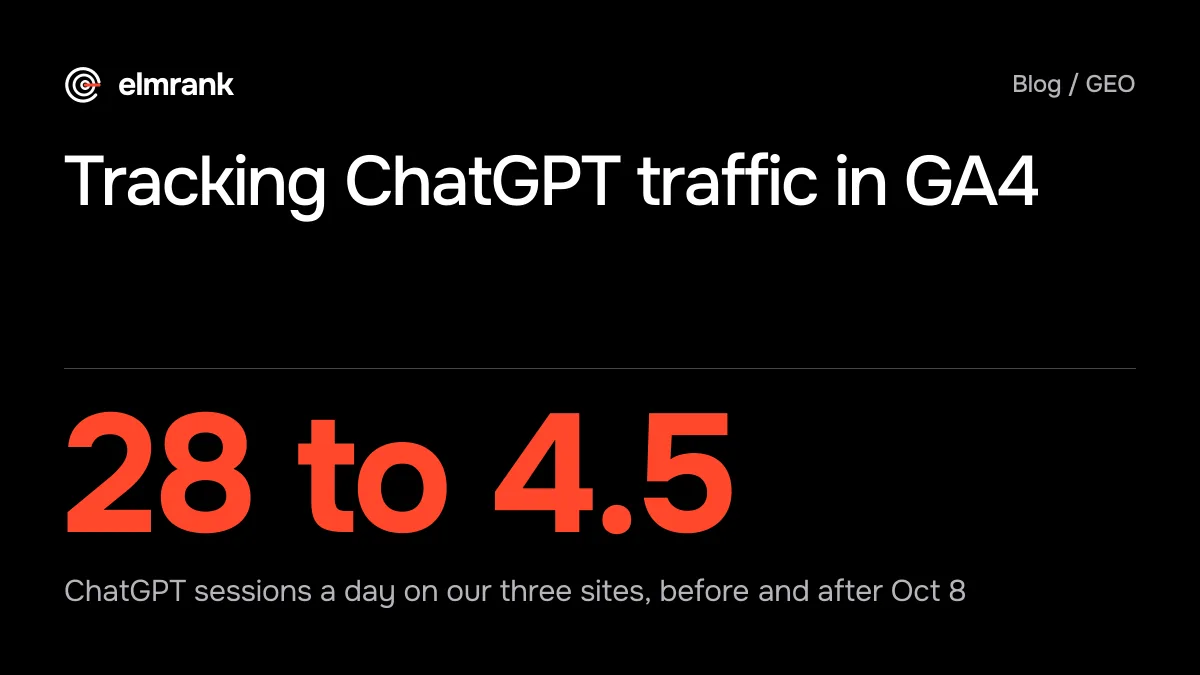
Where GA4 shows ChatGPT visits, what it needs to label them, and what we think happened when our ChatGPT sessions fell from 28 a day to 4.5 for six days.

By Tyler Phan6 min readLast reviewed
Part of our guide to AI search and GEO
On this page
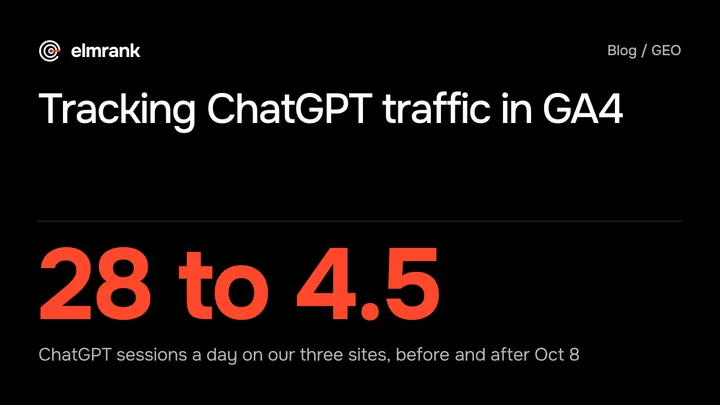
From September 1 to October 7, Google Analytics recorded 1,040 sessions from ChatGPT on the three content sites we run. That's 28 a day on average, and never fewer than 18. From October 9 to October 14 it recorded 27 in six days, or 4.5 a day. Then it went back up: 23 on October 15, 23 on October 16 and 45 on October 17. Organic search sessions on the same sites fell by about a tenth from October 9 to 14, comparing their daily average with the two weeks before.
We don't think we lost our ChatGPT readers for those six days. The likelier change was in what reached the site with each visit, and that's the first thing to understand about tracking ChatGPT in GA4.
Where ChatGPT visits show up in GA4
GA4 has two places to look, and they should agree.
- 1Traffic acquisition reportReports, Acquisition, Traffic acquisition
- 2Channel row: AI AssistantAll AI chat sources together, not only ChatGPT
- 3Switch to Session source / mediumLook for chatgpt.com / ai-assistant
- 4Exploration with a filterSession source contains "chatgpt" or "openai"
The AI Assistant channel is the quick view. Google's definition says it covers visits "from sources like ChatGPT, Gemini, Deepseek, Copilot, or Grok," and that "It excludes Google's AI Overviews and AI Mode." Google's guide to those two features says they're counted in Search Console's "Web" search type (more on that below). To see ChatGPT on its own, switch the report's first column to Session source / medium. On our sites the ChatGPT rows read "chatgpt.com / ai-assistant," with a few stray "openai" rows (4 sessions since September 1), so we filter on both words when we build an exploration.
One limit applies to everything in GA4: it only counts visits where its tag runs. Visitors who block it are missing from these numbers, and so are most visitors who decline cookies where Consent Mode holds the tag back.
What GA4 needs to label a visit
GA4 doesn't know where a visitor was before they arrived. It reads two clues. Google's rule for the AI Assistant channel is that "The medium exactly matches 'ai-assistant'," and that "The medium is set to 'ai-assistant' and the campaign is set to '(ai-assistant)' if the referrer matches a list of AI Assistants." So the visit needs either a tag on the link or a referrer from a known assistant.
ChatGPT used to send the tag. OpenAI's Publishers and Developers FAQ said, in the copy the Internet Archive saved on October 4, 2026: "ChatGPT automatically includes the UTM parameter utm_source=chatgpt.com in referral URLs, enabling clear tracking and analysis of inbound traffic from ChatGPT search results." When we opened that page on October 17, it redirected to an article about retiring ChatGPT Atlas.
On October 15, Search Engine Land reported that "ChatGPT links appear to have stopped including the utm_source=chatgpt.com parameter," after the release of GPT-6. It cited Adobe's Cedric Huesler, who reported that "links are now being opened using a method that suppresses referral information." Huesler looked at about 500 pages where ChatGPT had sent at least 5% of visits and compared October 9 to 13 with the week before: ChatGPT traffic down about 31,000 visits a day, direct traffic up about 26,000 a day on the same pages. The article adds that "OpenAI has not confirmed whether the change was intentional."
With no tag and no referrer, GA4 has nothing to go on, and the visit goes to Direct.
Huesler updated his post on October 15: "Relieved. It was a bug." He wrote that ChatGPT was tagging its links with utm_source=chatgpt.com again, and Search Engine Roundtable, which had covered the drop on October 14, added his update the same day. We haven't found a statement from OpenAI about the change or the fix.
What our three sites show
Our sites are a manhwa and anime site, a game news site and a card game site, all ours, not clients'. They report to one GA4 property, so we pulled sessions by day and site through the GA4 Data API on the morning of October 19.
| Days | ChatGPT sessions | Per day |
|---|---|---|
| Sep 1 to Oct 7 (37 days) | 1,040 | 28.1 (lowest day 18, highest 44) |
| Oct 8 | 19 | 19 |
| Oct 9 to Oct 14 (6 days) | 27 | 4.5 |
| Oct 15 to Oct 17 (3 days) | 91 (23, 23, 45) | 30.3 |
Our drop starts the same week as the one in Huesler's data, and from October 15, the day he said the tag was back, our numbers came back too. The mix is different, though. Of the 91 sessions from October 15 to 17, 56 went to the card game site, which averaged about 3 a day before the drop, and 17 to the manhwa site, which had averaged about 21. Before the drop, the manhwa site had 765 of the 1,040 sessions. We can't tell from GA4 whether its ChatGPT visits are still arriving untagged or ChatGPT is simply sending it fewer readers. October 18 hadn't ended in the GA4 property's time zone when we pulled the numbers, so it's left out.
We looked for the missing visits in Direct and couldn't pick them out. Between September 24 and October 7, Direct on the three sites ran anywhere from 525 to 1,280 sessions a day. From October 9 to 14 it averaged about 1,085 a day, but most of that rise is one day: October 12, with 2,450. The other five days stayed inside the earlier range. We don't know what caused October 12, and we can't tie it to ChatGPT, which sent us about 28 sessions a day in total before the drop. About 24 lost ChatGPT sessions a day disappear inside swings that size. Huesler's pages were chosen because ChatGPT sent them a lot of traffic. On a small site, you can't add the gap back from Direct, so the honest move is to report the number GA4 still sees and say it's a floor.
Other ways to count AI visits
None of these replaces the GA4 number, but each one tells you something GA4 can't.
- Landing pages. When ChatGPT cites a specific article, that's where its visitors land. A rise in Direct sessions that start on deep articles is a hint, not a count.
- Your server logs. OpenAI says that "When users ask ChatGPT or a CustomGPT a question, it may visit a web page with a ChatGPT-User agent." Those fetches show up in your host's access log whether or not anyone clicks through, so they measure ChatGPT reading your page, not visits.
- Search Console, for Google's own AI features. Google says sites in AI Overviews and AI Mode "are included in the overall search traffic in Search Console," inside the Performance report's "Web" search type. That's Google, not ChatGPT, and GA4 leaves it out of the AI Assistant channel.
Our post on how to get mentioned in ChatGPT covers the step before any of this: whether ChatGPT can reach your site at all.
How we report AI visits
Our monthly report puts AI referral visits next to your Search Console clicks and impressions, where they can be counted. October showed why that wording matters. For a client site we'd show the AI Assistant channel from GA4, mark October 9 to 14 as the days ChatGPT's links went out without a tag, and keep Search Console's numbers for Google's AI features separate, because GA4 doesn't count those as AI Assistant traffic at all. Our sample report, filled in with one of our own sites, has no AI numbers yet.
The plan is $500 for the first month (an SEO and GEO audit, the technical fixes, site design and a content plan), then $300 a month for up to 30 articles, ongoing fixes, hosting and that report. We don't promise mentions or AI visits; the one result our terms promise is about Google clicks. The AI search optimization page lists what we set up for AI answers.
Questions
Does GA4 count Google's AI Overviews as AI Assistant traffic?
No. Google's definition of the AI Assistant channel says it 'excludes Google's AI Overviews and AI Mode.' Google's guide to its AI features says sites shown in them are counted in Search Console, inside the Performance report's 'Web' search type.
Why does ChatGPT traffic show as Direct in GA4?
GA4 can only label a visit as ChatGPT if the link carries a tag such as utm_source=chatgpt.com or the browser passes chatgpt.com as the referrer. When neither reaches your site, GA4 has nothing to go on and files the visit under Direct. That happened to most ChatGPT visits from about October 9 to 14, 2026. The problem was reported fixed on October 15, when Adobe's Cedric Huesler, who had reported the drop, said it was a bug and that ChatGPT was tagging its links with utm_source=chatgpt.com again. As of October 19 we haven't found a statement from OpenAI confirming either the drop or the fix.
How we know this
Written by Tyler Phan. Every source below was read on the date shown; the page was last reviewed on Oct 19, 2026.
- Analytics Help, [GA4] Default channel group (AI Assistant definition and rule), accessed Oct 17, 2026
- OpenAI Help Center, Publishers and Developers FAQ (Internet Archive copy of Oct 4, 2026; the URL now redirects to a ChatGPT Atlas retirement page), accessed Oct 17, 2026
- Search Engine Land, ChatGPT appears to drop UTM tracking, making AI referral traffic harder to measure (Anu Adegbola, Oct 15, 2026), accessed Oct 17, 2026
- Search Engine Roundtable, OpenAI Drops UTM Parameters From ChatGPT Results (GPT-6) (Barry Schwartz, Oct 14, 2026, updated Oct 15 with Huesler's 'It was a bug'), accessed Oct 17, 2026
- OpenAI, Overview of OpenAI Crawlers (ChatGPT-User), accessed Oct 17, 2026
- Google Search Central, AI features and your website (how AI Overviews and AI Mode are counted), accessed Oct 17, 2026
- Elmrank, GA4 sessions by source, channel and day for the three sites we own (Data API, Sep 1 to Oct 17, 2026, pulled Oct 19); the sites are on our use cases page, accessed Oct 19, 2026
Send us your site.
We reply within 12 hours with what we'd fix first. Then we run it for you, technical SEO and content: $500 for the first month, then $300 a month for up to 30 articles. You don't need any technical knowledge, and you can cancel any time.