Does ChatGPT Use Bing? What Our Server Logs Show
Does ChatGPT use Bing? Partly. What OpenAI and Microsoft have said, what tests found, and which crawler reached 127 new posts on our sites first.

By Tyler Phan8 min readLast reviewed
Part of our guide to AI search and GEO
On this page
ChatGPT uses Bing, but not only Bing. Microsoft made Bing ChatGPT's default search in 2023, and OpenAI still says ChatGPT search works with "other search providers," with Microsoft's privacy statement linked. OpenAI also runs its own search crawler, and in 2025 a report said it had been using Google's results too.
Our server log adds one more piece. On the three content sites we run, about manhwa and anime, video games and trading card games, 127 posts were published between October 8 and 21, 2026. OpenAI's crawler fetched more of them than Bing's did, and its median first visit came hours earlier. ChatGPT itself opened 43 of them before Bingbot had fetched a live copy.
What OpenAI and Microsoft have said
The public record is short, and it doesn't all point the same way.
| When | Who | What they said |
|---|---|---|
| May 2023 | Microsoft (Yusuf Mehdi, Bing blog) | "we are bringing Bing to ChatGPT as the default search experience" |
| October 2024 | OpenAI, launching ChatGPT search | It "leverages third-party search providers, as well as content provided directly by our partners" |
| November 2024 | OpenAI's VP of Engineering, in an AMA after the launch, as quoted by Search Engine Roundtable | "we use a set of services and Bing is an important one" |
| August 2025 | The Information, as reported by Tom's Guide | OpenAI had been using Google results scraped through SerpApi |
| October 2026 | OpenAI's help page on web search | ChatGPT search "sometimes partners with other search providers"; for how they handle queries, it links Microsoft's privacy statement and Shopify's privacy policy |
Each line quotes the source listed at the end of this post, read on October 22, 2026.
OpenAI's help page also says how the partners are used: ChatGPT "typically rewrites your query into one or more targeted queries that it sends those providers." So when ChatGPT searches through a provider, it searches for a shorter query of its own, which can differ from what you typed.
What other people's tests found
Two tests point to Bing. In November 2024, Search Engine Roundtable quoted a LinkedIn post by Ivan Hristov, who wrote that "it appears that most searches are powered by Bing's index," and that after he triggered a Bing penalty on one of his sites, "it disappeared from ChatGPT search results too." In February 2025, Seer Interactive asked ChatGPT about 100 questions and matched more than 500 citations against Google's and Bing's results for the same questions: "More than 87% of ChatGPT search citations matched Bing's top 20 organic results for the same question, compared with just 56% for Google."
One test points to Google. Tom's Guide reported in August 2025 that Abhishek Iyer, a former Google engineer, "created dummy web pages that appeared only in Google's index," and that when he asked ChatGPT about them, "the bot responded with information pulled from those very pages." The same article cites The Information's report that OpenAI had been using data scraped from Google Search through SerpApi.
These can all be true at once. Each test is one site or one set of questions at one moment, and OpenAI's help page doesn't say which provider answers which search. Seer's match is also a correlation: ChatGPT citing the pages Bing ranks fits Bing being a source, but it would also happen if both picked the same well-known pages on their own. Our log lets us compare OpenAI's own crawler with Bing's on the same new pages.
What our server log showed
Our sites share one server, and its access log records every request. We took everything from October 8, 2026 at 00:00 UTC to October 22 at 10:30 UTC and counted a request as Bingbot's, OAI-SearchBot's, ChatGPT-User's or Googlebot's only when it came from an address on that company's published list. Requests that only used the name were left out. The log doesn't record which site a request was for, so we credited a page to a site only when its address is in that site's sitemap and no other.
Then we took the 127 posts on the three content sites with a publication date from October 8 to 21 and found, for each crawler, its first successful fetch of each post.
| Crawler | Posts fetched | Median after publishing | First to arrive |
|---|---|---|---|
| OAI-SearchBot (OpenAI search) | 97 | 1.4 hours | 54 posts |
| Bingbot | 82 | 14.3 hours | 34 posts |
| ChatGPT-User (a live chat) | 80 | 48 hours | 15 posts |
| Googlebot | 77 | 55 hours | 16 posts |
OpenAI describes the two crawlers differently. OAI-SearchBot "is used to surface websites in search results in ChatGPT's search features." ChatGPT-User is what ChatGPT sends when "users ask ChatGPT or a CustomGPT a question" and it visits a page; OpenAI says it "is not used for crawling the web in an automatic fashion."
OpenAI's crawler doesn't wait for Bing's. It fetched 15 more of the new posts than Bingbot did, and its median time from publishing to a first visit was about 13 hours shorter. On the 67 posts both crawlers fetched, OAI-SearchBot got there first on 39. That's close enough to half that it could be chance, so we wouldn't say it usually beats Bingbot on the same post. What it shows is that the two crawl on their own schedules.
ChatGPT opened pages Bing hadn't fetched
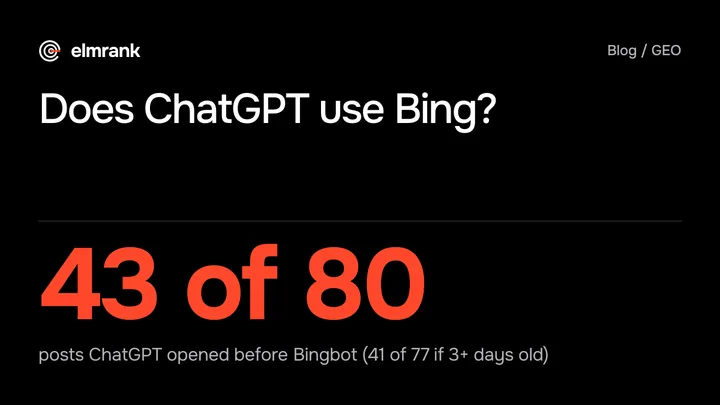
ChatGPT-User requests are the clearest sign that ChatGPT opened a page for someone, because OpenAI ties them to a user's question. ChatGPT opened 80 of the 127 new posts that way.
- Before Bingbot
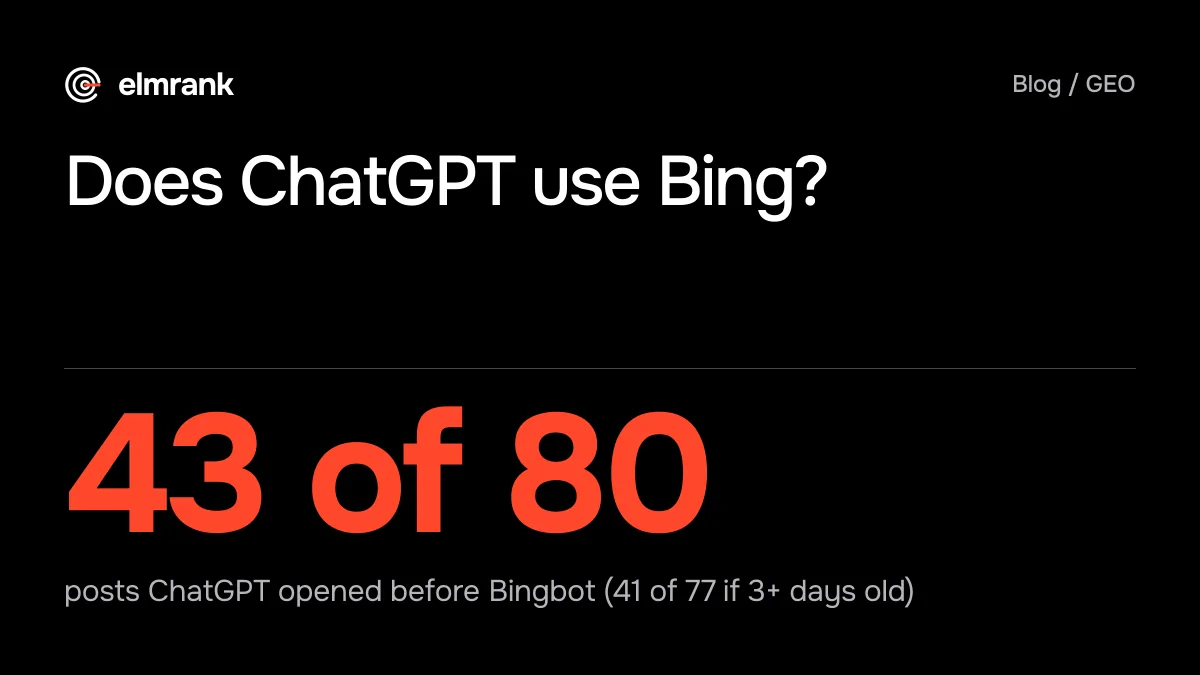
- 43 of 80
- posts ChatGPT opened before Bingbot's first successful fetch; for 24 of them Bingbot had none by the end of the log
- Before Bingbot and OAI-SearchBot
- 20
- neither crawler had fetched the live post yet
- Before all three crawlers
- 15
- Googlebot hadn't either
Posts published in the last days of the log gave Bingbot less time to arrive, so we ran the same count again on the 77 posts ChatGPT opened that were at least three days old when the log ended. ChatGPT opened 41 of them before Bingbot's first fetch of the live post, and 19 before both Bingbot and OAI-SearchBot.
So ChatGPT doesn't need Bing to have crawled a page before it can open it. How it found those 20 addresses, the log can't tell us. For 8 of the 20, ChatGPT-User had requested a home page in the three minutes before; our server hosts several sites on one log, so we can't tell which site's home page it was, but following a link from there is one possibility. A user pasting the link is another, and so is a search provider other than Bing.
There's a limit on the other side too. Bing can know a page's address before Bingbot fetches it, from a sitemap or a submission, so "Bingbot hadn't fetched it" isn't proof that the page was missing from Bing. Our log shows Bing learning addresses early: Bingbot asked for 37 of the 127 posts before their publication time, 50 requests in all, and 44 of those got a 404. The 14.3-hour median is the time to Bingbot's first fetch of the live post, and for those 37 Bing had the address before the post went up. What "Bingbot hadn't fetched it" does tell us is that, as far as our log shows, Bingbot hadn't yet fetched the published post from our server.
On our own new site
elmrank.com went live on October 14. By the end of the same log, 46 of its posts were live. Googlebot had fetched all 46. Bingbot had fetched one post, two days after we published it, and our contact form page, /start, five times. OAI-SearchBot and ChatGPT-User, counted from OpenAI's addresses, had requested none of the 60 pages we can attribute to our site. OpenAI's third crawler, GPTBot, did visit. OpenAI says it collects content "that may be used in training our generative AI foundation models." On the morning of October 14 (UTC), about six hours before our first posts went up, it fetched /use-cases, /pricing, /about, /terms and /privacy. Each request named our home page as the referrer, which is how we know they were for our site. In the same minute an OAI-SearchBot address read our robots.txt.
One address that isn't on OpenAI's lists requested three of our pages within four seconds on October 20, calling itself GPTBot twice and OAI-SearchBot once. Without the address check, it would have looked like GPTBot had reached one of our posts and OAI-SearchBot one of our service pages. From OpenAI's own addresses, neither had.
We first counted this in how to get mentioned in ChatGPT, three days after launch, when neither crawler had fetched our blog or service pages. Eight days in, Bingbot had fetched one of our posts, and none of OpenAI's three crawlers had fetched any. On our content sites, which are months old, OpenAI crawls new posts within hours, so we read our own result as a delay for a new site. IndexNow didn't bring Bingbot to our posts either: in the 24 hours after we sent it 58 URLs, Bingbot fetched 1 of the 51 we could check, and does IndexNow work has that log.
What we'd do
- Allow OAI-SearchBot in robots.txt and at your CDN or firewall; OpenAI says sites opted out of it won't be shown in ChatGPT search answers
- Verify your site in Bing Webmaster Tools and submit your sitemap; Microsoft made Bing ChatGPT's default search in 2023, and an OpenAI VP called it an important one of ChatGPT's services in 2024
- Keep your pages indexed in Google as well; one test and one press report point to ChatGPT using Google results
- Search your access log for OAI-SearchBot and ChatGPT-User and check each address against OpenAI's published lists
- Count ChatGPT visits separately in GA4: a ChatGPT-User fetch is ChatGPT reading the page, and a visit is a person clicking through
The first item matters most for ChatGPT search. OpenAI says sites that opt out of OAI-SearchBot "will not be shown in ChatGPT search answers, though can still appear as navigational links." The address check matters because the names are easy to fake, as our own log showed. Our AI crawler user agents post lists the names and the address lists to check them against, and tracking ChatGPT traffic in Google Analytics covers the visits.
Crawler access in our AI search service
Our AI search optimization service sets up a robots.txt that lets the OpenAI, Anthropic and Perplexity crawlers in, unless you want them out, as part of the first month's audit and setup. The plan is $500 for the first month and $300 a month after. Send us your site and within 12 hours we tell you whether the OpenAI, Anthropic and Perplexity crawlers can reach your pages today.
Questions
Does ChatGPT use Google or Bing?
OpenAI doesn't name one. Microsoft announced Bing as ChatGPT's default search in 2023, and OpenAI's help page today says ChatGPT search "sometimes partners with other search providers" and links Microsoft's privacy statement. In 2025 The Information reported that OpenAI had also used Google results scraped through SerpApi. OpenAI runs its own search crawler as well, OAI-SearchBot.
Is ChatGPT search powered by Bing?
Bing is one of its sources, not the only one. On our three content sites, OpenAI's own crawler fetched 97 of 127 new posts, with a median of 1.4 hours after publishing, and Bingbot 82, with a median of 14.3 hours. ChatGPT opened 43 posts before Bingbot had fetched a live copy (41 of 77 among posts at least three days old).
How do I get my website into ChatGPT search?
Let OAI-SearchBot in: OpenAI says sites that opt out of it "will not be shown in ChatGPT search answers, though can still appear as navigational links." Then get your pages indexed in Bing and in Google, since both have been reported as sources, and check your access log for OAI-SearchBot and ChatGPT-User against OpenAI's published address lists.
How we know this
Written by Tyler Phan. Every source below was read on the date shown; the page was last reviewed on Oct 31, 2026.
- Microsoft Bing Blog, Bing at Microsoft Build 2023: Continuing the Transformation of Search (Yusuf Mehdi, May 23, 2023), accessed Oct 22, 2026
- OpenAI, Introducing ChatGPT search (October 31, 2024), accessed Oct 22, 2026
- Search Engine Roundtable, Bing Powers ChatGPT Search (Barry Schwartz, November 4, 2024), accessed Oct 22, 2026
- Seer Interactive, 87% of SearchGPT Citations Match Bing's Top Results (Christina Blake, Alisa Scharf, February 6, 2025), accessed Oct 22, 2026
- Tom's Guide, ChatGPT Is Using Google Search To Answer Your Questions (Amanda Caswell, August 22, 2025), reporting The Information, accessed Oct 22, 2026
- OpenAI Help Center, Searching the web with ChatGPT, accessed Oct 22, 2026
- OpenAI, Overview of OpenAI Crawlers, accessed Oct 22, 2026
- Bing, bingbot IP ranges (bingbot.json), accessed Oct 22, 2026
- Elmrank, VPS access log (October 8 to 22, 2026), the sites' sitemaps and post dates, checked against Bing's, OpenAI's and Google's published address lists, accessed Oct 22, 2026
Send us your site.
We reply within 12 hours with what we'd fix first. Then we run it for you, technical SEO and content: $500 for the first month, then $300 a month for up to 30 articles. You don't need any technical knowledge, and you can cancel any time.