How to Find Orphan Pages: What Crawling Our Sites Showed
How to find orphan pages: compare your sitemap and Search Console with a crawl from the home page. What that found on our sites and what Google did with it.

By Tyler Phan8 min readLast reviewed
Part of our guide to site structure and internal links
On this page
An orphan page is a page on your site that no other page links to, so a visitor or a crawler that follows links can't reach it. It can still be live, in your sitemap and even in Google. Google's advice on links is short: "Every page you care about should have a link from at least one other page on your site."
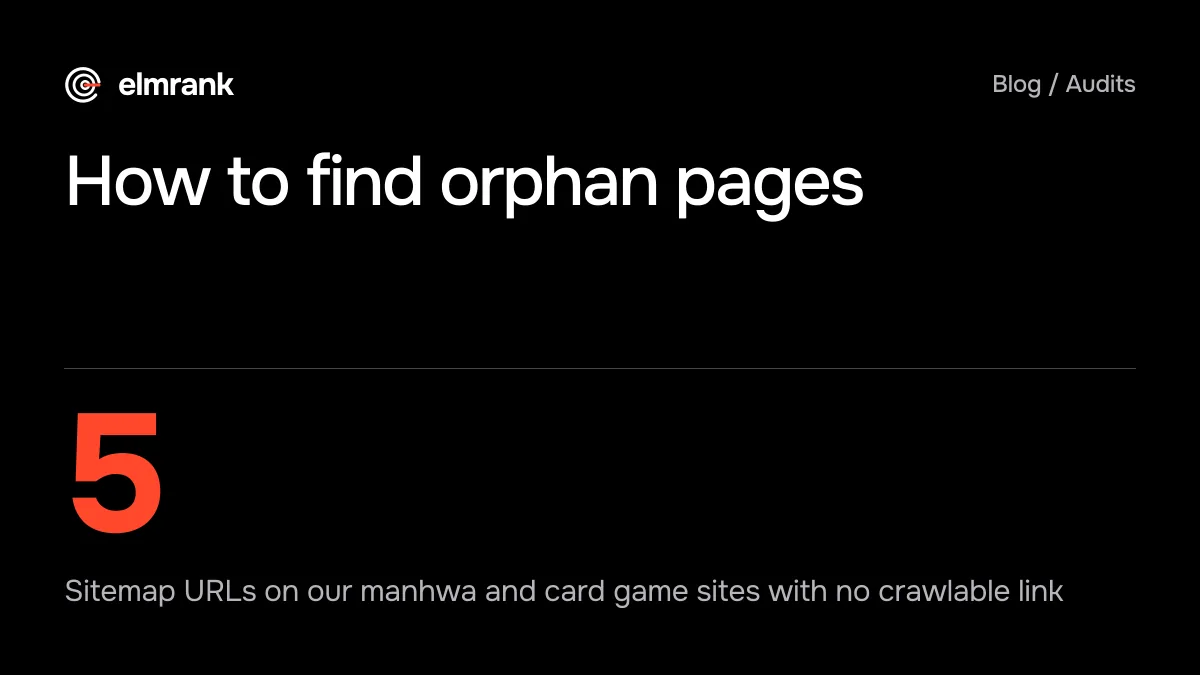
To find orphan pages you need two lists: the pages you want found, and the pages a crawler reaches by following links from your home page. Whatever is on the first list and missing from the second is orphaned. We ran that comparison on October 22, 2026 on two of the content sites we run, one about manhwa and anime and one about a trading card game, and on elmrank.com. This post shows how, what turned up, and what Google had done with those pages.
What counts as an orphan page
Screaming Frog, whose crawler has an orphan pages report, puts it this way: it counts "any URL where there is no observed linking path from the start point of a crawl (generally the homepage) as an orphan page." The page may have links from other orphans. What it lacks is a path from the front door.
The link has to be one a crawler can follow. Google says it "can only crawl your link if it's an <a> HTML element … with an href attribute," and that "Google can't reliably extract URLs from <a> elements that don't have an href attribute or other tags that perform as links because of script events." A button, a dropdown or a search form can take a person to a page and still leave it orphaned for Google.
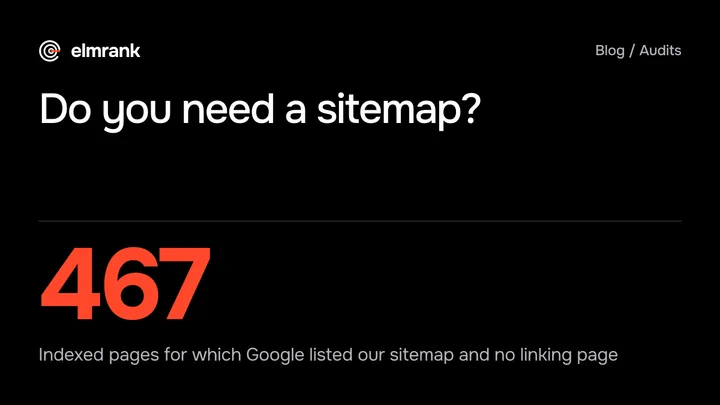
Links aren't the only way Google finds a page. Google's guide to how Search works says pages are discovered when "Google extracts a link from a known page to a new page," and also "when you submit a list of pages (a sitemap)." Our own numbers back that up: in do you need a sitemap, 467 of the 1,761 indexed pages we checked had only the sitemap listed as a source. So an orphan in your sitemap will often be indexed. It just has no link from the rest of your site, which is how people get to it and one of the signals Google uses to judge what the page is about.
How we looked for ours
We crawled each site from its home page with a short script that does what a site crawler does: fetch the page, collect every <a href> to the same site, and follow them until nothing new turns up. It kept list pages with a page number and dropped other query strings. Then we compared what it reached with two lists:
- every URL in the site's sitemap, read at the start of the crawl;
- every page with impressions in Search Console from September 22 to October 19.
For the sitemap URLs the crawl didn't reach, we added Google's view from URL Inspection the same day: whether the page was indexed and which linking pages Google listed for it.
| Site | Sitemap URLs | Pages the crawl reached | Orphans in the sitemap |
|---|---|---|---|
| Manhwa and anime | 594 | 1,104 | 3 |
| Card game | 807 | 1,665 | 2 |
| elmrank.com | 67 | 67 | 0 |
Crawl from the home page, October 22, 2026. The crawl reaches more pages than the sitemap lists because it also follows links to list pages, tag pages and pages with a noindex tag. Our internal links post counted the same sitemaps two hours earlier; the manhwa sitemap gained one URL in between.
Every other sitemap URL was at most four clicks from the home page, and on the card game site at most three. elmrank.com is small enough that every page is one or two clicks away, and every page other than the home page has at least two others linking to it.
What the five orphans were
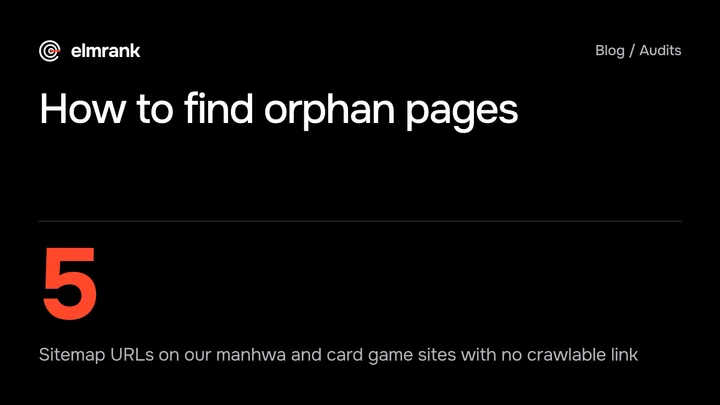
- Manhwa site tag pages, orphan pages 1, 2 and 3
- Card game site tag pages, orphan pages 4 and 5
All five were tag pages, three on the manhwa site and two on the card game site. On the manhwa site, a post shows its first four tags as links and keeps the rest behind a button that reveals them when clicked. A crawler doesn't click it, so a tag that only ever appears fifth or later on its posts never gets a link. On the card game site, posts don't show their tags as links, and post cards in lists show at most two, so a tag that never makes a post's first two can end up with no link at all.
We never decided to hide those five. They fell out of how many tags each template shows, and we only saw it because the crawl compared the two lists.
What Google did with them
Google had indexed all five. URL Inspection on October 22 showed every one as "Submitted and indexed," with last crawls between September 19 and October 20.
The card game site's two tag pages had 9 impressions and no clicks from September 22 to October 19. Google listed no linking page for either of them; for one it listed the sitemap file itself as the referring page. For these two, the sitemap was enough for indexing.
The manhwa site's three tag pages were different. Google listed two or three linking pages for each, eight in all, and none of them has a link to the tag that a crawler can follow today. On five of the eight, the tag's address appears in the page's script data but not in a link. The other three don't mention it at all now. We can't tell whether Google picked the address out of the script data or remembered a link from an earlier version of the page. The API describes the list as "URLs that link to the inspected URL, directly and indirectly," so it isn't proof that a page links there today.
Whether a link would have helped these pages rank, we can't say. Screaming Frog's guide argues that orphans "won't be passed internal PageRank." Google's guide says it uses links "as a signal when determining the relevancy of pages." We have no comparison that isolates either.
What Search Console knows that your crawl doesn't
The sitemap only covers pages you still list. Search Console's page list also includes pages you've forgotten about, and comparing it with the crawl turned up three kinds of them.
The first is the live orphan outside the sitemap. On the manhwa site, one post answered with a normal page, carried no noindex tag, had no link from anywhere on the site and wasn't in the sitemap, yet it had 521 impressions and 5 clicks in those four weeks. Nothing in our process would have shown it except this comparison.
The second is the removed page that still gets searches. On the manhwa site, 54 pages with impressions in those four weeks answered 404 on October 22. A page that people still find deserves a redirect to its closest replacement.
The third is the redirected page. The card game site had 190 old addresses with impressions, now redirecting, most of them card pages. Those are fine as long as the redirect lands on the right page.
The other way round: linked, but not in the sitemap
The crawl also showed pages that are linked and indexable but missing from the sitemap. There were 124 on the manhwa site and 70 on the card game site, almost all tag pages. They're not orphans, since links reach them, but they're the same mismatch from the other side: if you want them in search, list them; if you don't, give them a noindex tag.
The same crawl caught a few broken links as well. On the card game site, 69 pages linked to seven category addresses that answered 404. A crawl from the home page finds those at no extra cost.
How to find and fix orphan pages
- 1List what you want foundSitemap URLs, plus the Pages list from Search Console's Performance report
- 2Crawl from the home pageFollow <a href> links only, as Google does
- 3Compare the twoListed but not reached = orphan; reached but not listed = sitemap gap
- 4Link it or drop itA link from a related page, or out of the sitemap with a noindex, redirect or 404
On a small site the crawl needs no script. Screaming Frog's free version crawls up to 500 URLs, enough for elmrank.com's 67; the crawl of our two content sites reached 1,104 and 1,665 pages, so we wrote our own.
For each orphan, decide whether you want it found. If you do, link to it from the page a reader would expect it on: a category, a hub or a related post. Use a plain link, not a button or a form. On the manhwa site that means every tag a post has, in the HTML, even if some are visually tucked away; on the card game site, a post's tags as links on the post itself.
If you don't want the page found, take it out of the sitemap and either give it a noindex tag, redirect it to the page that replaced it, or let it return 404 if nothing did. The combination to avoid is a page that's live, in the sitemap and linked from nowhere.
Run the comparison again after template changes. All five of our orphans came from how two templates show tags, and nobody rereads every page a template change touches. If you want to see where your pages sit in the link structure more broadly, how many internal links a page needs has the counts from the same sites.
Orphan pages in our first-month audit
Site structure and internal links are part of the first month's audit in our technical SEO service, and we make the fixes ourselves, in your code. The plan is $500 for the first month and $300 a month after. The sitemap-against-crawl comparison above is one of the first checks we'd run on your site.
Questions
Are orphan pages bad for SEO?
They're harder for Google to find and for visitors to reach. Google's link guide says "Every page you care about should have a link from at least one other page on your site." On our sites, a sitemap made up for the missing link as far as indexing goes: all five orphaned pages on our manhwa and card game sites were indexed, and for two of them Google listed no page linking in. What we can't measure is whether a link would have helped them rank.
Can Google index an orphan page?
Yes, if it finds the URL another way: a sitemap, an external link, or a link that used to exist. Google indexed all five of our orphaned sitemap URLs, two of them with no linking page listed in URL Inspection, and one page on our manhwa site that was in neither the sitemap nor a link had 521 impressions in four weeks.
How do I find orphan pages for free?
Export your sitemap URLs and the Pages list from Search Console's Performance report, then crawl the site from the home page with a crawler that follows only links. Screaming Frog's free version crawls up to 500 URLs. Every URL in your lists that the crawl didn't reach is orphaned. On a larger site, a short script does the same job.
How we know this
Written by Tyler Phan. Every source below was read on the date shown; the page was last reviewed on Oct 30, 2026.
- Google Search Central, Link best practices for Google, accessed Oct 22, 2026
- Google Search Central, In-depth guide to how Google Search works, accessed Oct 22, 2026
- Google for Developers, Search Console API: URL Inspection result (referringUrls), accessed Oct 22, 2026
- Screaming Frog, How To Find Orphan Pages, accessed Oct 22, 2026
- Elmrank, crawl of our manhwa and card game sites and elmrank.com from the home page, URL Inspection and Search Console page data (October 22, 2026), accessed Oct 22, 2026
Send us your site.
We reply within 12 hours with what we'd fix first. Then we run it for you, technical SEO and content: $500 for the first month, then $300 a month for up to 30 articles. You don't need any technical knowledge, and you can cancel any time.