Do You Need a Sitemap? What Google Did With Ours
Do you need a sitemap? Google says small, well-linked sites may not. What URL Inspection showed for 1,930 sitemap URLs on our four sites, and what we'd do.

By Tyler Phan7 min readLast reviewed
Part of our guide to technical SEO
On this page
A sitemap is a file that lists the pages you want search engines to find, usually at /sitemap.xml. Whether you need one depends on how easy your pages are to find without it. Google's own answer: "If your site's pages are properly linked, Google can usually discover most of your site." It also says that "in most cases, your site will benefit from having a sitemap."
We run three content sites and elmrank.com, all with sitemaps submitted in Search Console. To see what the file does in practice, we put 1,930 sitemap URLs from the four sites through URL Inspection, which shows for each URL the sitemaps and the linking pages Google knows about, and we looked at what happened in our server log when we submitted elmrank.com's sitemap at launch.
What Google says
Google's guide lists when you might need a sitemap: when "Your site is large," when "Your site is new and has few external links to it," and when "Your site has a lot of rich media content (video, images) or is shown in Google News." It lists when you might not: when your site is "small," which it defines as "about 500 pages or fewer," when it's "comprehensively linked internally," and when you don't have many media files or news pages you want in search.
It's just as clear about the limits. "A sitemap helps search engines discover URLs on your site, but it doesn't guarantee that all the items in your sitemap will be crawled and indexed." Submitting one "is merely a hint: it doesn't guarantee that Google will download the sitemap or use the sitemap for crawling URLs on the site."
Three rules from the build guide:
- List only pages you want in search: "Include the URLs in your sitemap that you want to see in Google's search results."
- Use full addresses. Google "will attempt to crawl your URLs exactly as listed," so
https://www.example.com/page, not/page. - Stay under the limits: 50,000 URLs or 50 MB uncompressed per file, with a sitemap index file above that.
You can submit the file in Search Console or name it in robots.txt with a Sitemap: line, which Google will "find … the next time we crawl your robots.txt file." We do both.
What URL Inspection shows on our sites
For each URL, Google's URL Inspection API returns two lists that matter here: the sitemaps that list the URL "as known by Google," and the pages that link to it. Google warns that neither is complete, so a URL with no linking page listed may still have links. It's still the closest you can get to seeing how Google found a page.
On October 20, 2026 we inspected the sitemap URLs of our three content sites: all of them on the manhwa and card game sites, and 557 on the game news site. That gave 1,863 results.
| What Google listed for the URL | URLs | Indexed |
|---|---|---|
| At least one linking page | 1,201 | 1,138 (95%) |
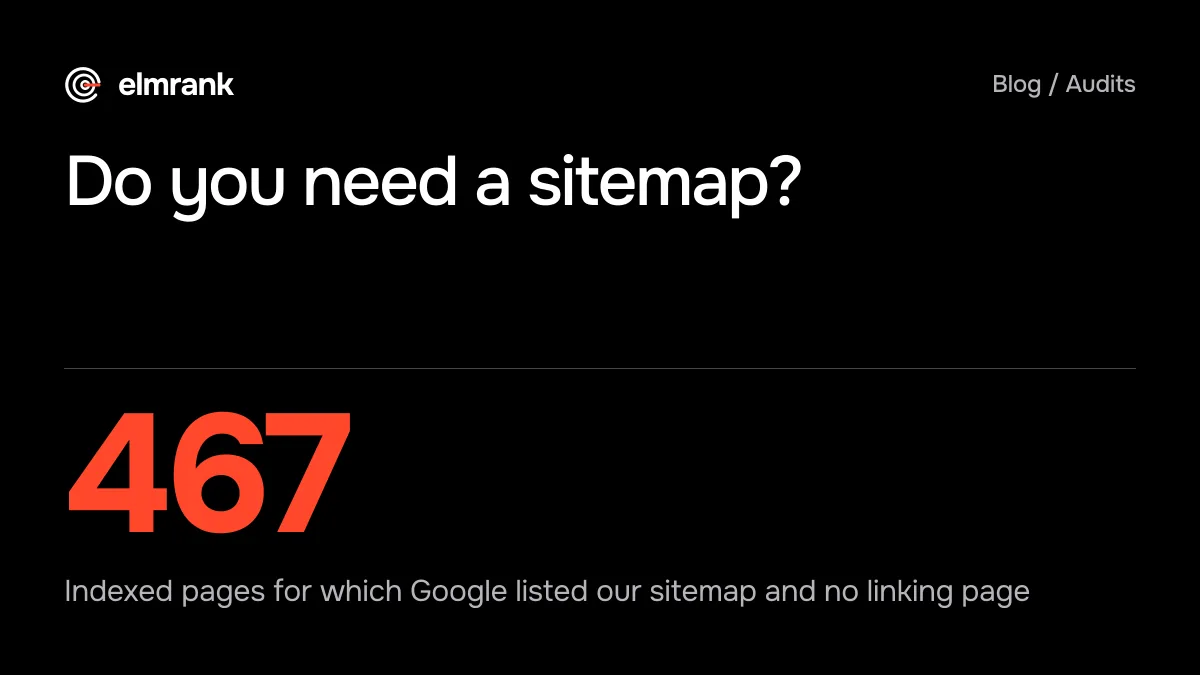
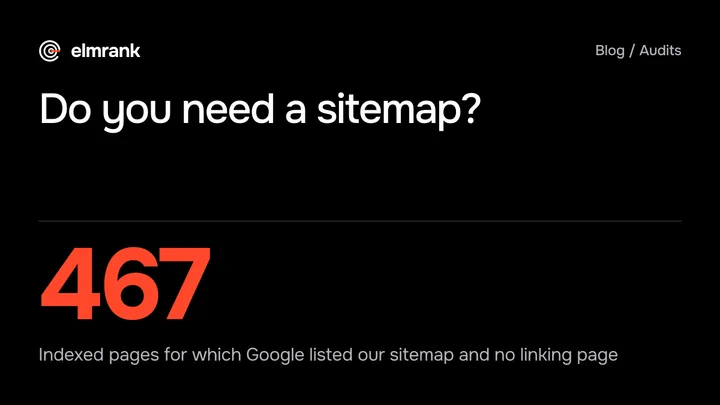
| Our sitemap, no linking page | 494 | 467 (95%) |
| Neither | 168 | 156 (93%) |
URL Inspection API, three content sites, October 20, 2026. Every URL in the table is in our sitemaps.
For about a quarter of the indexed pages, the sitemap was the only source Google showed us, and those pages were indexed as reliably as the ones with a linking page listed. Google doesn't always name the sitemap, though. It listed ours for 1,427 of the 1,863 URLs, although every one of them is in it, which fits its note that the list is "Not guaranteed to be an exhaustive list, especially if Google did not discover this URL through a sitemap."
elmrank.com, at 67 URLs, is the small, well-linked case Google describes. On October 22, Google listed a linking page for 53 of them and our sitemap for 33, and 62 were indexed. The five it didn't know yet were pages we had put live that same day.
What happened when we submitted ours
We launched elmrank.com on October 14 with 25 posts, live between 18:30 and 19:49 Vietnam time, and submitted the sitemap in Search Console at 18:58:40. Three seconds later a Googlebot address on Google's published list asked our server for /sitemap.xml. Our server runs eight sites and its log doesn't record which one a request was for, so we can't tell which sitemap requests that evening were ours. Googlebot asked for a /sitemap.xml six other times between 17:00 that afternoon and 03:00 the next morning, once at 18:31, a minute after our first posts went live. We think the request three seconds after our submission was ours, but that rests on the timing alone.
Reading the sitemap didn't mean fetching the posts straight away. Googlebot's first visit to a launch post came 2 hours and 44 minutes after that request, and it had visited 22 of the 25 within 7.5 hours of their going live. Request Indexing wasn't an option that night: all five tries were refused because the daily quota was used up. So the sitemap and our internal links got those 22 posts found; how long it takes Google to index a page follows them from the first fetch to the index.
Since then Google has kept reading the file without being asked. Search Console showed it downloaded again on October 18 and on October 20, and we haven't resubmitted it.
- 1Sitemap submitted18:58:40, 25 posts already live
- 2Sitemap read3 seconds later, by a verified Googlebot address; ours, going by the timing
- 3First post fetched2 h 44 min after the sitemap was read
- 422 of 25 fetchedwithin 7.5 hours of going live, no Request Indexing
What a sitemap won't do
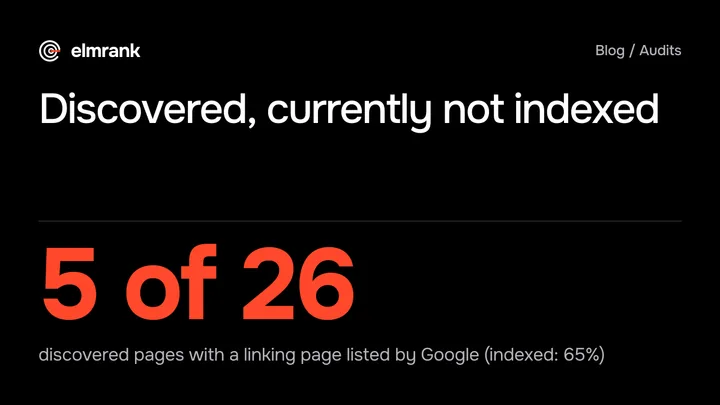
A sitemap won't get a page indexed. Of the 1,863 URLs above, 26 were "Discovered - currently not indexed," which means Google knew them, often from the sitemap, and hadn't fetched them yet; discovered, currently not indexed looks at those. Another 16 were "Crawled - currently not indexed": fetched and left out.
It also won't fix a sitemap that lists the wrong pages. Two of our own sitemaps listed pages Google had seen a noindex tag on: the full census that morning found 43 on the manhwa and card game sites, and crawled, currently not indexed covers that mistake. Each one asks Google to index a page that tells it not to. When we fetched every URL in those two sitemaps on October 22, none carried the tag, yet URL Inspection that day reported 90 URLs in the two sitemaps as noindex (the card game sitemap had grown since the census). It goes by Google's last crawl of each page, which for some of them was in May, so a fix doesn't show in the report until Googlebot comes back.
And the Sitemaps report won't tell you how many pages are indexed. The API still has a field for it, but it returned 0 wherever it appeared on our four sites, and Google's reference says of it: "Deprecated; do not use." Filter the Page indexing report by sitemap instead, or inspect the URLs.
lastmod, changefreq and priority
Google's build guide says: "Google ignores <priority> and <changefreq> values." It uses lastmod "if it's consistently and verifiably (for example by comparing to the last modification of the page) accurate," and it counts changes to "the main content, the structured data, or links on the page" as significant, "however an update to the copyright date is not."
Our sitemap still carries changefreq and priority, because we set them when we built it; they do nothing for Google. We set lastmod only on posts and on the two pages that list them, from the date a post was published or last reviewed, and leave it off pages where we don't track changes. A lastmod that moves on every deploy tells Google nothing it can trust. The same field feeds IndexNow on our site: when a post's lastmod changes, the next deploy sends that URL to Bing and the other IndexNow engines, as does IndexNow work describes.
What we'd do
- Have one sitemap at the site root, generated from your pages, not written by hand
- List only pages you want in search: no noindex pages, redirects, 404s or duplicate URLs
- Use full https addresses that match each page's canonical URL
- Set lastmod from real content changes, or leave it out
- Submit it in Search Console and add a Sitemap: line to robots.txt
- Check the Sitemaps report for errors after big changes, then the Page indexing report filtered by sitemap
- Link every new page from a page Google already crawls; the sitemap is the backup, not the plan
If your site is small and every page is a click or two from the home page, a missing sitemap isn't what's holding it back, and we'd look at indexing and the pages themselves first. Why your website isn't showing on Google goes through those causes.
Where this sits in our plan
The sitemap, robots.txt and indexing checks are part of the first month's audit in our technical SEO service, and we make the fixes ourselves, in your code. The plan is $500 for the first month and $300 a month after. To see what we'd fix first on your site, send it to us: the list is free, and we reply within 12 hours.
Questions
Does a sitemap help SEO?
It helps Google find pages; it doesn't help them rank. Google calls a submitted sitemap "merely a hint" and says it "doesn't guarantee that all the items in your sitemap will be crawled and indexed." On our three content sites, pages for which Google listed only the sitemap were indexed at about the same rate as pages with a linking page listed, 95% in both cases.
Should I put every page in my sitemap?
No, only the pages you want in search. Google's guide says to "Include the URLs in your sitemap that you want to see in Google's search results." Leave out pages with a noindex tag, redirects, 404s and duplicates. Two of our own sitemaps broke that rule: on October 20, 2026, Google reported 43 URLs in the manhwa and card game sitemaps as carrying a noindex tag. When we fetched every URL in them on October 22, none had the tag.
Do lastmod, changefreq and priority matter?
Google ignores changefreq and priority. It uses lastmod only "if it's consistently and verifiably" accurate, so set it to the date the page's content last changed in a way that matters, not to the date of your last deploy.
How we know this
Written by Tyler Phan. Every source below was read on the date shown; the page was last reviewed on Oct 29, 2026.
- Google Search Central, Learn about sitemaps, accessed Oct 22, 2026
- Google Search Central, Build and submit a sitemap (last updated July 8, 2026), accessed Oct 22, 2026
- Google for Developers, Search Console API: URL Inspection result (sitemap and referringUrls fields), accessed Oct 22, 2026
- Google for Developers, Search Console API: Sitemaps resource, accessed Oct 22, 2026
- Elmrank, URL Inspection of the sitemap URLs of the three sites we run (October 20, 2026) and of elmrank.com (October 22, 2026), our server's access log and Search Console's Sitemaps data, accessed Oct 22, 2026
Send us your site.
We reply within 12 hours with what we'd fix first. Then we run it for you, technical SEO and content: $500 for the first month, then $300 a month for up to 30 articles. You don't need any technical knowledge, and you can cancel any time.