How Long Does It Take Google to Index a New Page?
Google says indexing typically takes a day or so. On our new domain, Googlebot fetched 22 of 25 launch posts within 8 hours. Our logs, and what sped it up.

By Tyler Phan7 min readLast reviewed
Part of our guide to technical SEO
On this page
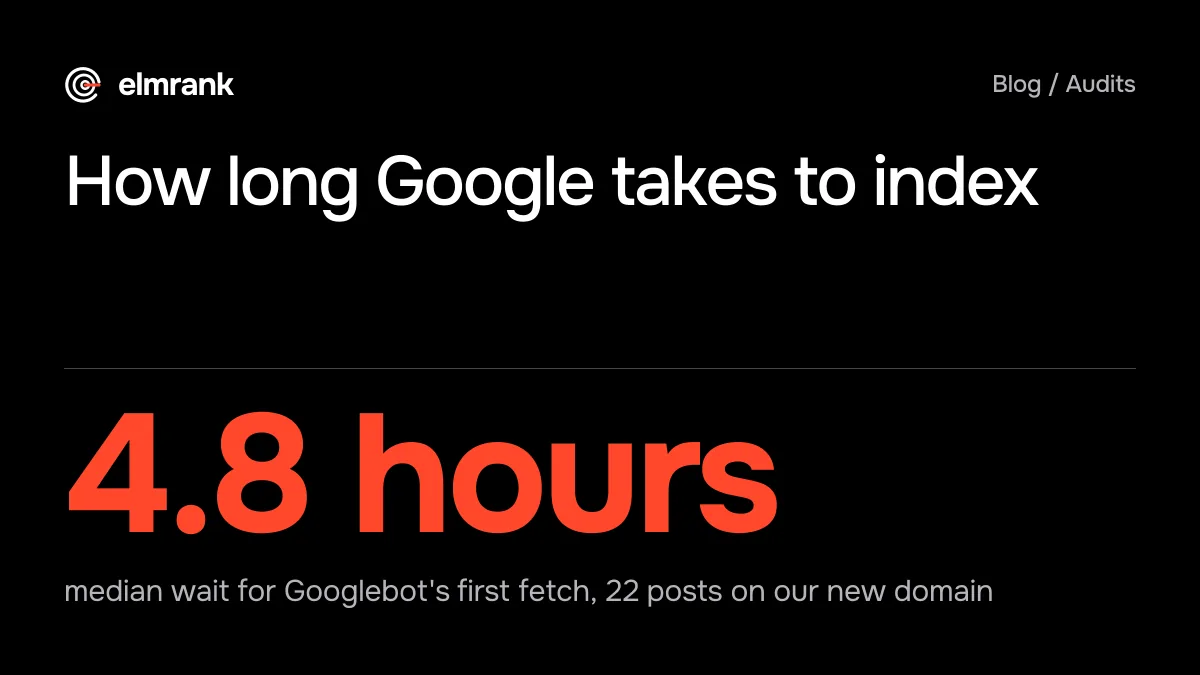
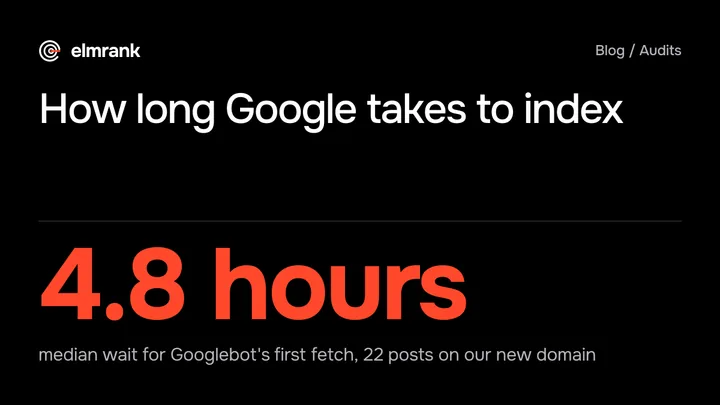
We launched elmrank.com on October 14 with 25 blog posts, on a domain registered the day before. That evening we tried Request Indexing five times between 18:35 and 19:04, for one post and one service page, and every try was refused because the daily quota was used up, so Google had to find the posts by itself. Googlebot fetched 22 of them within 3.1 to 7.5 hours of going live, and when we checked the next morning, URL Inspection showed all 22 as "URL is on Google."
How long it takes Google to index a new page depends a lot on the site. Ours is small, plain HTML and new, and these times are faster than most of what Google publishes, so read them as one site's numbers. Below is what Google says about timing, what our server log and Search Console recorded for the first 37 posts, and what Request Indexing changed.
- 1Page goes liveOur server answers 200
- 2Googlebot fetches it3.1 to 7.5 hours for 22 launch posts
- 3URL is on GoogleAll 22 by the next morning
- 4First impression20 of 25 by the next day
What Google says about timing
Google gives several answers, and they don't measure the same thing. The URL Inspection help covers a page you've asked it to index: "Indexing can take up to a week or two," and "Indexing typically takes only a day or so, but can take much longer in some cases. Submitting a request does not guarantee that the page will appear in the Google Index." The recrawl guide is about crawling: "Crawling can take anywhere from a few days to a few weeks." For a whole new site, the getting-started page says: "It can take a few weeks for Google to notice a new site, or any changes in your existing site."
The most detailed numbers came from a talk. At Search Central Live in Barcelona on October 2, Gary Illyes showed a fastest, typical and slowest time for each step, "based on Google's internal analysis," according to John Campbell's recap for ROAST.
| Step | Typical | Slowest |
|---|---|---|
| Discovery of a new URL | About 20 hours | Weeks to never |
| Sitemap processing | About 24 hours | Up to 14 days, or never (quality) |
| Indexing, end to end | About 1.5 hours | Months or never (quality) |
The recap defines end to end as the point when "all the critical processes finish successfully." Search Engine Journal, reporting on the same recap, notes that no sample size, period or definition of "typical" was given, and the slides weren't on Google's events page when it published. We read the table as a rough guide. Finding a URL takes most of the time, and processing it takes much less. The slowest column is where the word "quality" shows up, and that's the part no setting can fix.
Our launch, hour by hour
Our server log records every request with its time and user agent. We counted a request as Googlebot only when its user agent said Googlebot and its IP address fell inside the ranges Google publishes for its crawlers, one of the two checks Google's verification page describes. Other Google crawlers use the same ranges. We left out GoogleOther, which Google calls "the generic crawler that may be used by various product teams," and Google-InspectionTool, the URL Inspection fetcher, which Google says "has no effect on Google Search." Counted by IP alone, our times would look shorter: GoogleOther fetched 24 of the 25 launch posts a median 2.8 hours after they went live, each time before Googlebot did. For each post, "live" is the first time our server answered 200 for the URL, which was our own check right after each deploy. Index status comes from Search Console's URL Inspection, and first impressions from its Performance data.
- Fetched by Googlebot the same evening
- 22 of 25
- 3.1 to 7.5 hours after going live, median 4.8
- "URL is on Google" next morning
- 22 of 25
- checked about 14 to 17 hours after launch
- First impression by the next day
- 20 of 25
- Search Console dates, Pacific Time
The 25 posts went live between 18:30 and 19:49 Vietnam time, and we submitted the sitemap at 18:58. The first Googlebot visit to a post came 3.1 hours after it went live, the last of the 22 at 7.5 hours. The next morning, between about 10:10 and noon, URL Inspection showed the same 22 as on Google.
The other three hadn't been visited. Two were "URL is unknown to Google" and one was "Discovered - currently not indexed." We requested indexing for all three that morning, and Googlebot fetched them 14.6 to 17.2 hours after they had gone live. By October 19, 23 of the 25 launch posts were indexed. All 25 were on October 20.
Impressions are a separate clock, because a page only gets one when someone searches for something it ranks for. Four of the 25 posts had an impression on the day they went live (Pacific Time, which is how Search Console labels days), 16 on the next day, three within two or three days, and two have none yet. Search Console also says its data "is usually available in 2–3 days," so the last few days in any such count are provisional.
What Request Indexing changed
After launch we published 12 more posts and put 11 of them through Request Indexing (the twelfth already showed as on Google when we checked it). For those 11, Googlebot's first visit followed our requests.
| Posts | When we requested indexing | First Googlebot fetch after going live |
|---|---|---|
| 6 posts, Oct 16 and Oct 19 | Within the hour after publishing | 5 to 46 minutes |
| 3 posts, Oct 15 | About 4 hours after publishing | 3.8 to 3.9 hours |
| 2 posts, Oct 19 | About 4 to 6 hours after publishing | 3.9 and 5.9 hours |
Our request log records when each batch of requests finished, not each click. Googlebot's first fetch of each post came between 36 minutes before and 2 minutes after the end of the batch that requested it. On October 15, for example, the batch with three of our posts ended at 18:05 Vietnam time, and Googlebot fetched the three at 17:43, 17:47 and 17:49. Posts we requested hours after publishing weren't fetched until we did, though that wait was within the 3 to 8 hours the launch posts took on their own. This isn't a controlled test: the later posts went up on a domain Googlebot had already been crawling for a day or more, and that may account for part of the speed-up.
So on a small site, Request Indexing mostly buys you the first visit sooner. It doesn't decide whether the page is kept. Google says "requesting a recrawl multiple times for the same URL won't get it crawled any faster," and "There is a daily limit to how many index requests you can submit. If you want many pages indexed, try submitting a sitemap to Google." Our account shares that limit across several sites, and on launch night it was already used up.
When it takes longer
Indexing can also go backwards. On October 19, URL Inspection showed two of our launch posts as "Crawled - currently not indexed," though both had appeared in search results on October 14 and 15. By the next morning both were back to "Submitted and indexed," and Google hadn't crawled either since October 16. We hadn't edited either post since October 15. Our post on crawled, currently not indexed covers that status in detail.
If a page still isn't indexed after a week or two, we'd stop waiting and start checking. First the URL Inspection status, then whether a noindex tag, robots.txt or a canonical points Google away, and whether any other page links to it. Our post on why a website doesn't show on Google goes through those causes, and our technical SEO audit checklist has the rest. When everything technical is fine and the page stays out, Google's own table points to quality.
How to measure it on your site
- Write down the minute each new page goes live
- Search your server log for the page's path with Googlebot in the user agent, and confirm the IP belongs to Google (reverse DNS or Google's published IP ranges); GoogleOther and Google-InspectionTool come from the same ranges, so leave them out
- Run URL Inspection on the page the next day: look for "URL is on Google" and the last crawl date
- In the Performance report, filter to the page and note the first day with an impression; days are in Pacific Time, and the last 2 to 3 days are incomplete
- Use Request Indexing for the handful of pages that matter this week, and let the sitemap carry the rest
How we handle indexing for a client
Indexing is part of the technical work in the first month of our plan ($500): an SEO and GEO audit, then fixes to crawling, indexing, speed, schema and site structure, made by us in your code. After that, $300 a month covers up to 30 articles, ongoing fixes, hosting and a monthly report with your Search Console clicks and impressions. Our sample report is filled in with one of our own sites. We don't promise indexing times; the one result our terms promise is about Google clicks. The technical SEO page lists what the fixes cover.
How we know this
Written by Tyler Phan. Every source below was read on the date shown; the page was last reviewed on Oct 21, 2026.
- Search Console Help, URL Inspection tool (Request indexing), accessed Oct 20, 2026
- Google Search Central, Ask Google to recrawl your URLs, accessed Oct 20, 2026
- Google Search Central, Get your website on Google, accessed Oct 20, 2026
- ROAST (John Campbell), Google Search Central Live Deep Dive Barcelona, day 3 recap (Gary Illyes' timing tables, Oct 2, 2026), accessed Oct 20, 2026
- Search Engine Journal, Google Shows How Long Crawling, Indexing & Recovery Can Take (Oct 4, 2026), accessed Oct 20, 2026
- Google Crawling Infrastructure, Verifying requests from Google's crawlers and fetchers, accessed Oct 20, 2026
- Google Crawling Infrastructure, Google's common crawlers (GoogleOther, Google-InspectionTool), accessed Oct 20, 2026
- Search Console Help, Performance report: troubleshooting data (time lag and time zones), accessed Oct 20, 2026
- Elmrank, indexing timeline of elmrank.com's first 37 posts (our server log, Search Console URL Inspection and Search Analytics APIs, our Request Indexing log), checked Oct 20, 2026, accessed Oct 20, 2026
Send us your site.
We reply within 12 hours with what we'd fix first. Then we run it for you, technical SEO and content: $500 for the first month, then $300 a month for up to 30 articles. You don't need any technical knowledge, and you can cancel any time.