Long-Tail Keywords in SEO: What 28 Days of Our Data Show
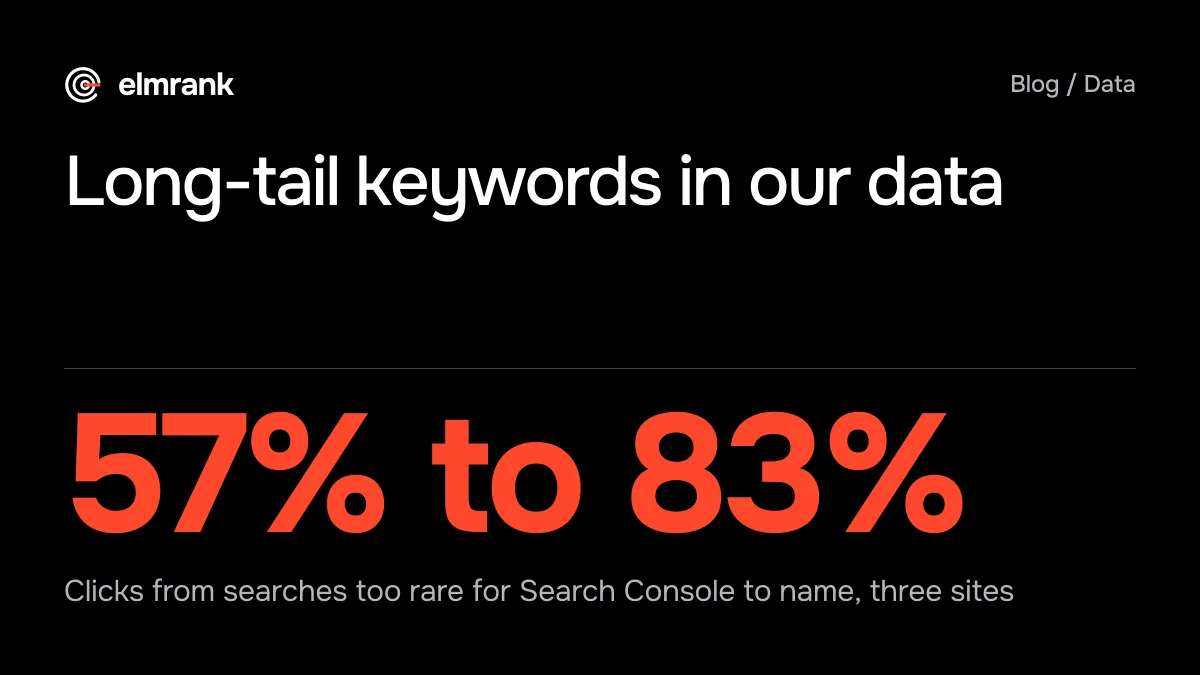
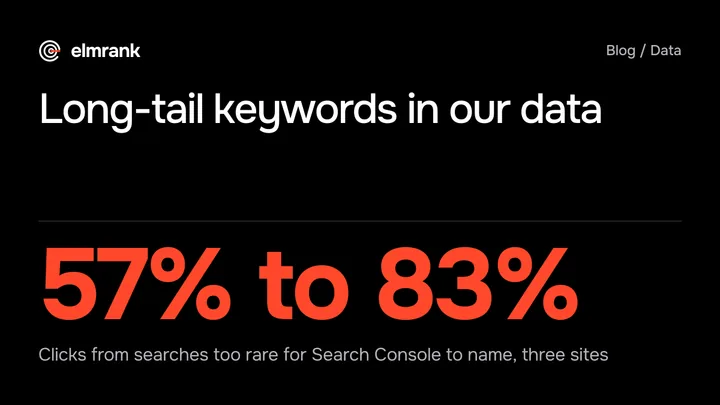
Long-tail keywords are searches few people make. On three sites we run, 57% to 83% of clicks came from searches so rare Search Console won't name them.

By Tyler Phan5 min readLast reviewed
Part of our guide to keyword research
On this page
A long-tail keyword is a search that few people make. Ahrefs' guide to the term puts it plainly: "So it is not the length of a keyword that makes it a long-tail. It's the search volume of that keyword." Long-tail searches tend to be longer because the extra words make them specific, and there are a lot of them. Google says "15% of the searches we process every day are ones we've never seen before."
We wanted to know how much of our own traffic sits in that tail, so we took 28 days of Search Console data, September 22 to October 19, 2026, for the three content sites we run: a manhwa and anime site, a game news site and a card game site.
The rarest searches don't even get a name
Search Console counts clicks from every search in its totals, but it only names some of them in the query table. Google explains why: "Anonymized queries are those that aren't issued by more than a few dozen users over a two-to-three month period." They stay in the totals and drop out of the table. By Ahrefs' definition (volume, not length), searches too rare for Google to name are the far end of the long tail; that link is our reading, not Google's.
On our sites the unnamed searches were most of the traffic:
| Site | Clicks | From named searches | From anonymized searches |
|---|---|---|---|
| Manhwa site | 16,893 | 43% | 57% |
| Game news site | 20,479 | 36% | 64% |
| Card game site | 4,741 | 17% | 83% |
Search Console, web search, final data, September 22 to October 19, 2026.
The card game site writes guides about specific cards and decks, and its searches are the most scattered of the three: more than four in five of its clicks came from searches Google wouldn't name. The same numbers show up in what a good CTR is in Search Console, where they limit what a query table can tell you.
How long our searches were
For the searches Search Console did name, we counted words (the query split on spaces) and added up 28 days per search.
| Words | Manhwa site | Game news site | Card game site |
|---|---|---|---|
| 1 | 1.3% of clicks, 0.4% CTR | 0.6%, 0.3% CTR | 1.1%, 0.4% CTR |
| 2 | 24.1%, 3.0% | 12.6%, 2.0% | 10.7%, 1.1% |
| 3 | 38.1%, 3.7% | 20.6%, 1.7% | 31.2%, 1.9% |
| 4 | 17.0%, 2.8% | 25.0%, 1.6% | 26.9%, 2.1% |
| 5 | 9.9%, 2.5% | 22.3%, 1.9% | 17.6%, 2.4% |
| 6 or more | 9.7%, 1.7% | 18.8%, 2.0% | 12.4%, 1.9% |
Share of named-search clicks and click-through rate (clicks divided by impressions) by number of words; named searches only.
Searches of three words or more brought 75% of those clicks on the manhwa site, 87% on the game news site and 88% on the card game site. One-word searches were 5% to 9% of the searches and about 1% of the clicks. On the manhwa site they sat at an average position of 4.0 and still turned only 0.4% of impressions into clicks. One word says little about what the person wants, so a page that answers one specific thing rarely fits it.
Longer wasn't always better, though. Click-through rate peaked at three words on the manhwa site, at five on the card game site and, by a small margin, at seven or more on the game news site. Length points to the tail. It doesn't make a search more likely to end on your page.
How thin the tail gets
Even among named searches, most were tiny. About half of them had one impression in four weeks: 51% on the manhwa site, 44% on the game news site and 50% on the card game site. Another 30% to 38% had two to nine. The searches that brought the most named clicks were the ones in between, with 10 to 99 impressions over the four weeks: 41%, 45% and 60% of named clicks.
The big searches mattered less than you'd guess. The 100 named searches with the most impressions on each site brought 13% of the manhwa site's clicks, 8% of the game news site's and 5% of the card game site's. A plan that chases only the biggest searches aims at that slice.
- 1Pick the questionOne specific thing a reader wants to know, in their words
- 2Answer it on one pageFully, so the variants of the question land there too
- 3Read Search ConsoleQueries with a handful of impressions show what else people asked
- 4Add or link, don't copyA new section or a link to the page that answers it
What to do with it
We wouldn't write one page per long-tail search. Most of those searches are variants of a question a single page can answer, and pages written for each variant can end up showing for the same searches; on our sites 19% to 27% of the searches Search Console names already brought up two or more of our pages, as keyword cannibalization shows. Pick a question, answer it fully, and read the page's queries in Search Console a few weeks later. Searches with a handful of impressions show what readers also wanted, and the fix is a new section or a link to a page that has it. The anonymized share is the reason to cover a topic well: no list of searches will show you most of it.
Read these numbers for what they are. They come from three entertainment sites that publish a lot, over four weeks, and only the named searches can be split by length. A business with a short list of products and a local market is likely to have a shorter tail. Still, if sites like these get most of their clicks from searches Google won't even name, a keyword list with search volumes describes only part of what people type.
Where this sits in our plan
In our SEO content service, the content plan starts from what your customers search for and is updated as the numbers come in, and each article opens with a direct answer to the search. The plan is $500 for the first month and $300 a month after, for up to 30 articles a month depending on your niche. To see what we'd fix first on your site, send it to us: the list is free, and we reply within 12 hours.
Questions
What is a long-tail keyword?
A search that few people make. It's usually longer and more specific than the popular searches around it, but as Ahrefs puts it, the number of searches is what makes it long tail, not the number of words. On our three sites, about half of the searches Search Console named had a single impression in four weeks, and the searches too rare to be named at all brought 57% to 83% of the clicks.
Are long-tail keywords easier to rank for?
Ahrefs says they are "(generally) a lot less competitive." Our data doesn't measure competition, so we can't confirm that for your niche. What it shows is where the clicks came from: on our sites, searches of three or more words brought 75% to 88% of the clicks we could see by query, and one-word searches got 0.3% to 0.4% of their impressions as clicks.
How do I find long-tail keywords for my site?
Start with your own Search Console. Open Performance, sort the Queries tab by impressions and look below the first page of rows: the searches with a handful of impressions show what people already find you for. Search Console leaves out the rarest ones, so read the questions in the named ones rather than counting them one by one.
How we know this
Written by Tyler Phan. Every source below was read on the date shown; the page was last reviewed on Oct 28, 2026.
- Google Search Central Blog, A deep dive into Search Console performance data filtering and limits (2022), accessed Oct 22, 2026
- Google, How Search works: Maximizing access to information, accessed Oct 22, 2026
- Ahrefs, Long-tail keywords: what they are and how to get search traffic from them (updated May 27, 2026), accessed Oct 22, 2026
- Elmrank, Search Console queries for the three sites we run, September 22 to October 19, 2026 (pulled October 22, 2026), accessed Oct 22, 2026
Send us your site.
We reply within 12 hours with what we'd fix first. Then we run it for you, technical SEO and content: $500 for the first month, then $300 a month for up to 30 articles. You don't need any technical knowledge, and you can cancel any time.