Keyword Cannibalization: What Our Search Console Data Shows
How to find keyword cannibalization in Search Console, and when it matters. On our sites one page got 90% of the clicks in 219 of 254 shared queries.

By Tyler Phan8 min readLast reviewed
Part of our guide to keyword research
On this page
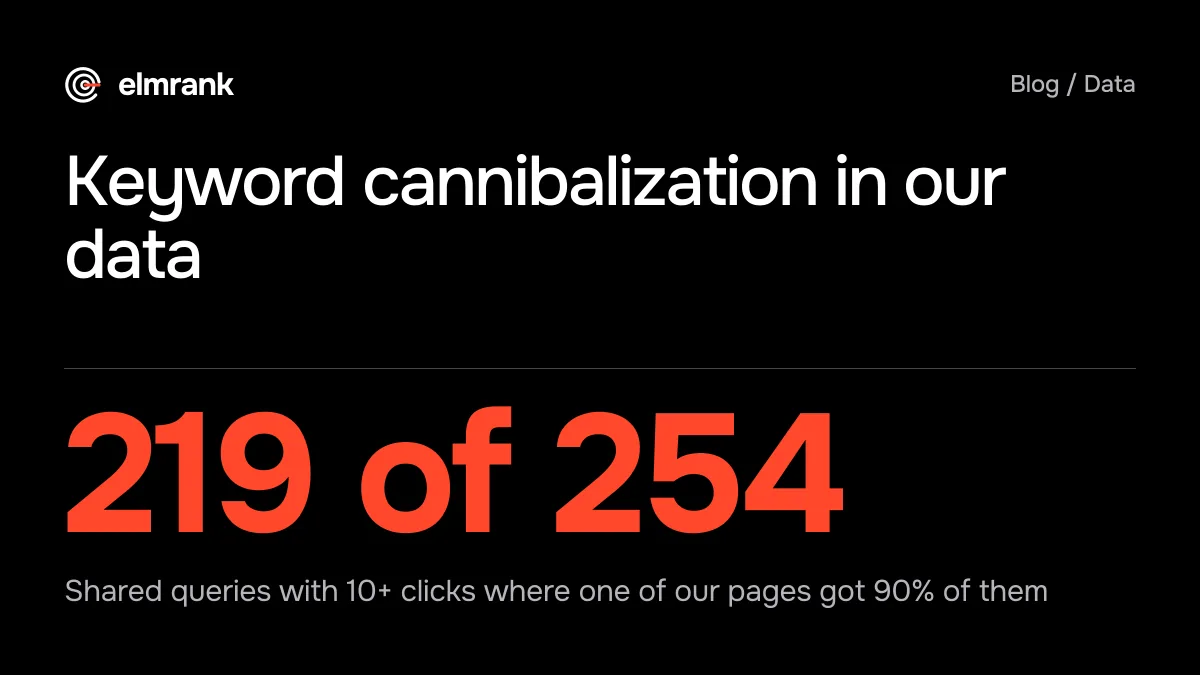
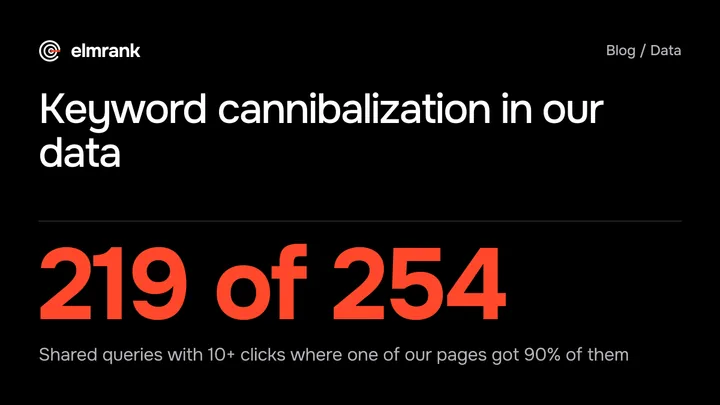
Keyword cannibalization is the worry that two or more pages on your site compete for the same search and drag each other down. It's easy to find in Search Console, and on our sites it was everywhere: 19% to 27% of the queries Search Console names brought up two or more of our pages. Usually one page took the clicks anyway. Of the 254 queries that sent at least 10 clicks and showed several of our pages, 219 sent at least 90% of those clicks to one page. The rarer case, where a second page held a real share of the impressions, did worse: on our two bigger sites those queries got less than half the click-through rate of queries where one page clearly led. We can't tell yet whether the split is the cause or a sign of something else.
This post shows how we measured it on the three sites we run and on elmrank.com, which cases we'd act on, and how to check your own site.
What Google says about it
We didn't find the term in the Search Central pages we read for this post. The clearest statement we found is a Bluesky thread from September 2025. Someone asked how they'd know which of their pages Google was considering for a query, to avoid cannibalization, now that Search Console only showed URLs in roughly the top 20 positions. John Mueller answered that Search Console "shows data for when pages were actually shown, it's not a theoretical measurement," and added: "(IMO it's not really "cannibalization" if it's theoretical.)" His next post:
"All that said, I don't know if this is actually a good use of time. If you have 3 different pages appearing in the same search result, that doesn't seem problematic to me just because it's "more than 1". You need to look at the details, you need to know your site, and your potential users."
Replying to himself, he went on: "Reduce unnecesary duplication and spend your energy on a fantastic page, sure. But pages aren't duplicates just because they happen to appear in the same search results page."
So the useful questions are whether two pages that show for one query are duplicates of each other, and whether the split costs you clicks.
How we measured it
We pulled Search Console rows by query and page for the three sites (a manhwa and anime site, a game news site and a card game site, all ours), September 22 to October 19, 2026, web search, final data, and the same rows by day. Rows grouped by page are counted per page: Google's Performance report help says data grouped by page "is aggregated by page," so when two of our pages appear in one search, each gets an impression.
We sorted each query into one of three groups:
- One page: only one of our pages had impressions for it in the four weeks.
- Several pages, one leading: two or more had impressions, but the second page had less than 20% of them.
- Split: the second page had 20% or more of the query's page impressions, with at least 50 in total.
Queries where a second page had 20% or more but the total stayed under 50 page impressions fit neither group: 2,197 on the manhwa site, 2,776 on the game news site and 792 on the card game site. They count as queries showing several pages in the first table, and they're too small for the click-through comparison, which starts at 50 impressions.
How common it was
| Manhwa site | Game news site | Card game site | |
|---|---|---|---|
| Queries with impressions | 21,954 | 32,561 | 7,801 |
| Queries showing several of our pages | 27% | 22% | 19% |
| Their share of page impressions (each page counted) | 89% | 77% | 65% |
| Split queries | 69 | 314 | 5 |
| Split queries' share of clicks | 2% | 12% | 2% |
Queries that brought up several pages held most of the impressions. Part of that is how the table counts: when two of our pages show in one search, that search adds two page impressions, so these queries weigh more in the share than they would in the site's total. Part is probably that these are the bigger queries, where Google has more chances to try more of a site's pages. A split, where a second page holds a real share, was rare: 69 queries on the manhwa site and 5 on the card game site. The game news site had 314, which held 12% of its clicks. In 377 of the 388 split queries across the three sites, both pages were blog articles.
Clicks usually went to one page anyway. Of the queries with 10 or more clicks that showed several of our pages, one page got at least 90% of the clicks in 106 of 118 on the manhwa site, 106 of 128 on the game news site and 7 of 8 on the card game site.
Did the split cost clicks?
We compared click-through rates by group, for queries with at least 50 impressions whose average position was 1 to 6. The position and click figures come from Search Console's query rows, which count a search once however many of our pages it showed.
| Group | Manhwa site | Game news site | Card game site |
|---|---|---|---|
| One page | 1.7% (42 queries) | 1.5% (72) | 2.5% (22) |
| Several pages, one leading | 4.5% (347) | 5.2% (219) | 3.9% (22) |
| Split | 2.0% (22) | 1.4% (64) | 1 query |
Queries where several of our pages showed and one led had the best click-through rate on every site (the card game site had a single split query, too few to compare). Split queries did about as well as single-page queries, but at positions 1 to 6 they got less than half the click-through rate of queries where one of our pages clearly led: 2.0% against 4.5% on the manhwa site and 1.4% against 5.2% on the game news site. At positions 7 to 10 the two sites disagree. On the game news site split queries got 1.3%, the same as one-leading queries and above the 0.6% of one-page queries. On the manhwa site they got 0.8%, under half the 1.8% of one-leading queries.
We can't tell from this whether the split costs clicks. The groups differ in other ways. Queries where Google shows several of our pages with one ahead may be the ones where it already sees the site as a strong match, and a split may mark a query where Google is unsure which page fits, a query that might get fewer clicks whichever page it showed. So we treat a split as a reason to read both pages, starting with the queries that switch.
On the manhwa site, 29 of the 69 split queries changed their leading page three or more times in four weeks; on the game news site, 66 of 314 did. A query that bounces between two pages day by day may mean Google can't tell which one answers it better. Those are the pairs we read side by side.
Our own case: two posts on SEO retainers
elmrank.com had one real pair in its first week. Our post on SEO content subscriptions went live on October 14 and our post on SEO retainer cost on October 16. On October 15, retainer searches brought up the subscription post alone, at position 91 or so. From October 16 both showed: across 13 queries containing "retainer," 9 brought up both posts. The retainer post averaged position 70 and the subscription post 92. For "seo monthly retainer" itself, the retainer post had 45 impressions at 68.3 and the subscription post 32 at 90.2. Neither got a click.
We didn't merge them. The subscription post is about buying articles by the month, and the retainer post is about agency retainers, and both are still far from page one, where a split might matter. On October 22 we added one line to the subscription post that links the retainer post for readers comparing retainers, so the link and its anchor should point Google at the page we want for those searches. It's too early to see the effect.
How to find keyword cannibalization in Search Console
- 1List shared queriesQuery and page rows, 28 days; queries with 2 or more pages
- 2Keep the real splitsSecond page has 20% or more of the impressions
- 3Check by dayDoes the leading page keep changing?
- 4Read both pagesSame question answered twice, or two different needs?
For one query, open Performance, add a query filter set to "Exact query," and switch to the Pages tab. For a whole site, the Search Console API returns up to 25,000 rows per request; ask for the query and page dimensions, then query, page and date for the daily check. The response says whether the rows were aggregated "byPage," which is what you want here.
Then decide per pair:
- Same question, one page clearly weaker: merge the useful parts into the stronger page and 301 redirect the weaker one. Google lists redirects as "a strong signal that the target of the redirect should become canonical."
- Two pages that must both exist but are near copies, such as print and web versions: use rel="canonical," which Google calls "a strong signal that the specified URL should become canonical."
- Different questions that overlap: keep both, make the difference plain in the title and first heading, and link from one to the other with the words you want each to rank for.
- One page already leads and gets the clicks: leave it.
Where this sits in our plan
Overlapping pages can come up in the first month's audit, under site structure and internal links, which is part of our technical SEO service; we make the fixes ourselves, in your code. New articles come from a content plan that starts from what your customers search for, as the SEO content service page describes. The plan is $500 for the first month and $300 a month after. To see what we'd fix first on your site, send it to us: the list is free, and we reply within 12 hours.
Questions
Is keyword cannibalization bad for SEO?
Two pages showing for one query isn't proof of a problem. Google's John Mueller wrote in September 2025 that three of your pages in one result "doesn't seem problematic to me just because it's 'more than 1'". On our two bigger sites, at positions 1 to 6, queries that brought up several of our pages with one clearly ahead got 4.5% and 5.2% of their impressions as clicks. Queries where a second page held 20% or more of the impressions got 2.0% and 1.4%, about the same as queries that showed only one page. We can't tell whether the split causes that or only marks queries where Google is unsure which page fits. Look closer when two pages answer the same question, trade places from day to day, and neither gets the clicks the position should bring.
How do I check for keyword cannibalization in Google Search Console?
In the Performance report, filter by one query and open the Pages tab to see every page that got impressions for it. To check a whole site, export query and page rows through the Search Console API and list the queries where a second page has a large share of the impressions, say 20% or more. Then look at those pages by day: if the leading page keeps changing, look closer.
Should I merge pages that cannibalize each other?
Merge when both pages answer the same question and one is clearly weaker: move the useful parts into the stronger page and 301 redirect the weaker one. Google calls a redirect "a strong signal that the target of the redirect should become canonical." If the pages serve different intents, keep both, make the difference plain in titles and headings, and link from the weaker one to the stronger one for the shared topic.
How we know this
Written by Tyler Phan. Every source below was read on the date shown; the page was last reviewed on Oct 26, 2026.
- John Mueller (Google) on Bluesky, reply on cannibalization and Search Console data, September 20, 2025, accessed Oct 22, 2026
- Google Search Central, How to specify a canonical URL with rel="canonical" and other methods, accessed Oct 22, 2026
- Google Search Central, Redirects and Google Search, accessed Oct 22, 2026
- Search Console Help, Performance report (Search results), accessed Oct 22, 2026
- Google for Developers, Search Console API: Search Analytics query, accessed Oct 22, 2026
- Elmrank, Search Console query and page data for the three sites we run (September 22 to October 19, 2026) and for elmrank.com (October 14 to 19), pulled October 22, accessed Oct 22, 2026
Send us your site.
We reply within 12 hours with what we'd fix first. Then we run it for you, technical SEO and content: $500 for the first month, then $300 a month for up to 30 articles. You don't need any technical knowledge, and you can cancel any time.