Is the Google Sandbox Real? What Four New Domains Show
Is the Google sandbox real? Two of our sites averaged a top-10 position in their first week on brand-new domains. What four new domains showed us.

By Tyler Phan6 min readLast reviewed
Part of our guide to SEO for a new website
On this page
The Google sandbox is the belief that Google holds every new site back for months, however good it is, before letting it rank. Google has denied it for years. In 2019 John Mueller answered a question about limits on new pages this way, as Search Engine Journal reported: "We use a ton of factors for crawling, indexing, and ranking, it's possible that in certain situations, some pages show up well quickly, while others take longer. There's no fixed rule or timeline there."
A denial doesn't tell you what a new site will see, so we looked at ours. We registered four domains in 2026, three for content sites (manhwa and anime, game news, a card game) and one for elmrank.com, and we have Search Console for each from its first day.
What Google says about new sites
Google's documentation talks about delay, not a penalty. Its guide to getting on Google lists a new site as one reason a page may be missing: "It can take a few weeks for Google to notice a new site, or any changes in your existing site." Its SEO Starter Guide says the same about changes in general: "Some changes might take effect in a few hours, others could take several months."
Neither describes a months-long hold that applies to every new domain. The sandbox idea comes from site owners who saw new sites rank poorly for a while, and the question is whether that comes from age itself or from things that come with being new: few pages indexed, few links, no history on the searches that matter.
Google has left a little room, though. In 2005, as an attendee at a search conference reported and Search Engine Journal quotes, Matt Cutts, then head of Google's webspam team, "said that there wasn't a sandbox, but the algorithm might affect some sites, under some circumstances, in a way that a webmaster would perceive as being sandboxed." No hold on new domains as such, then, but a new site can still look held back.
What our four domains did
We checked each domain's registration date in its registry's record and looked for earlier use of the domain in the Wayback Machine. Then we lined that up with Search Console from the first day with impressions.
| Site | Domain registered | First week | First 30 days |
|---|---|---|---|
| Manhwa site | May 12, 2026, no earlier captures | Position 8.3, 34 clicks | Position 9.2, 508 clicks |
| Game news site | April 11, 2026; a game review site in 2008, archived until 2012 | Position 12.7, 21 clicks | Position 8.3, 3,920 clicks |
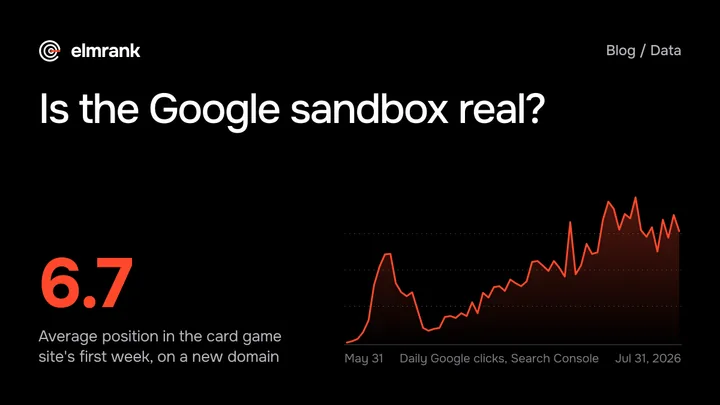
| Card game site | May 31, 2026, no earlier captures | Position 6.7, 547 clicks | Position 7.4, 2,458 clicks |
| elmrank.com | October 13, 2026, no earlier captures | Position 71.9, 3 clicks (6 days) | Not yet |
Average position weighted by impressions; Search Console, web search, final data. Day 1 is the first day with impressions, the day after registration on all four domains.
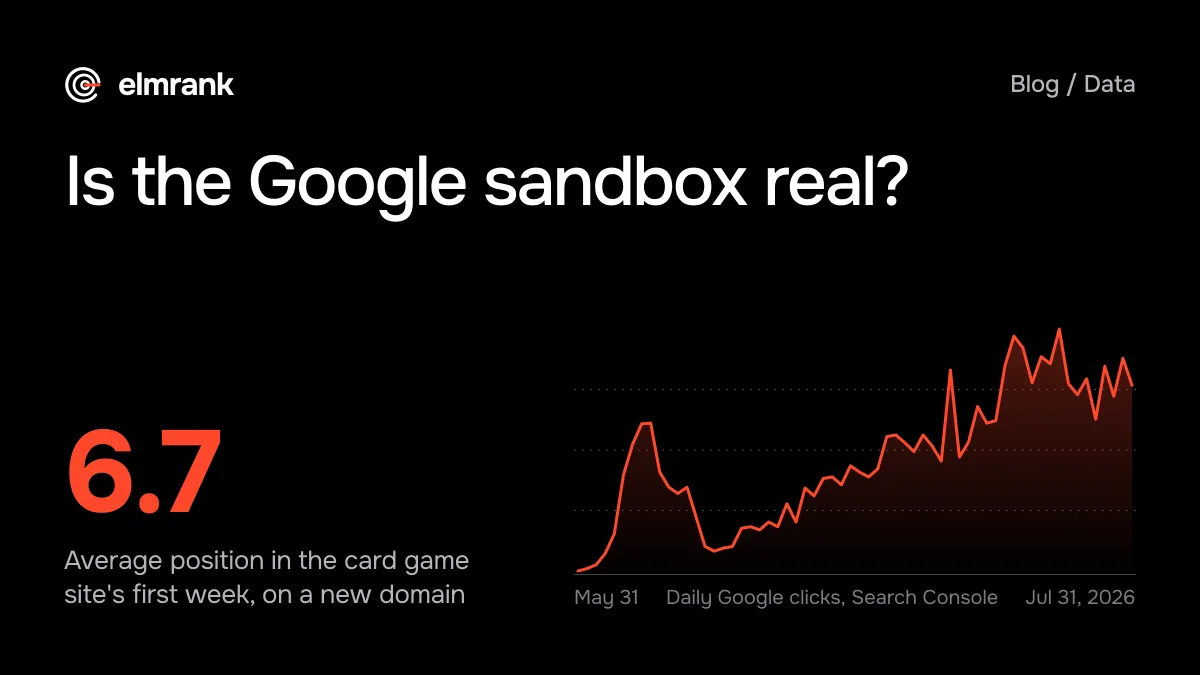
On every domain, Google showed pages the day after the domain was registered. The card game site's first day already had 3 clicks at position 7.1, and its first two months looked like this:
The searches Search Console names tell the same story. In its first week, 391 of the card game site's 494 named searches averaged a top-10 position, and they carried 94% of its named impressions. On the manhwa site it was 86 of 149 searches and 52% of impressions. A sandbox that holds every new domain back would have kept those numbers near zero.
How Google found each domain within a day we can only partly say. On elmrank.com we submitted the sitemap on day 1, the evening the first posts went up; Request Indexing was refused that night because the daily quota was used up. For the content sites, Search Console's Sitemaps report keeps only the latest date each sitemap was submitted, and on all three that date is later than day 1, so we can't tell whether a sitemap came first.
Did the older domain help?
Not that we could see. The game news domain had been registered before: the Wayback Machine has captures of it from 2006 to 2012, and in 2008 it was a game review site with a forum. We registered it again on April 11, 2026. If history on a domain bought a head start, this site should have led. It was the slowest of the three in its first week, at position 12.7 with 21 clicks, then picked up: 3,899 clicks in days 8 to 30 at position 8.3. It wasn't short of pages either. In its first week Google showed 47 of its pages in search, against 35 on the manhwa site and 21 on the card game site, the one with 547 clicks.
Three sites can't settle whether domain age matters, because the sites also differ in topic, in how much they published and in who searches for them. What they do show is that two domains with no earlier history ranked well from the first week, which a fixed sandbox wouldn't allow.
Why our own site looks sandboxed
elmrank.com fits the sandbox story better. In its first six days, Search Console showed it 2,147 times at an average position of 71.9, and only 7 of the 336 searches it named averaged a top-10 position. Three clicks came in, on three posts sitting around position 60.
It isn't blocked from the index. Googlebot fetched 22 of our 25 launch posts within 3.1 to 7.5 hours, and the next morning URL Inspection showed all 22 as on Google; how long it takes Google to index a page has the timeline. The difference from the content sites is the searches. The content sites answer narrow questions about series, games and cards. Our posts are about hiring and running SEO, where agencies and SEO software companies already rank. We read the low positions as competition, though six days of data can't rule out that the domain's age plays a part.
- 1Is it indexed?URL Inspection or the Page indexing report for your key pages
- 2Where do you show?Performance report: impressions and position by query
- 3Who ranks above you?Search your best queries and look at the top 10
- 4Aim narrower, link inSpecific questions first, links from pages Google already crawls
What to do if a new site seems stuck
Start with the index, because a page that isn't indexed can't rank at any age. If your pages are missing, why your website isn't showing on Google walks through the causes, and discovered, currently not indexed covers pages Google knows about but hasn't fetched.
If the pages are indexed and showing far down the results, look at the searches. A new site that only targets broad, contested searches is likely to sit far down for a while, as ours does, sandbox or not. Our content sites started with narrow questions about series, games and cards. Write those first and link new pages from pages Google already crawls.
Then give it weeks, not days, before you judge, and keep judging after the first good month: two of our content sites had their best week around day 70 to 75, counted from the first click, and then fell, as how long SEO takes shows.
Where this sits in our plan
Indexing and site structure are part of the first month's audit in our technical SEO service, and we make the fixes ourselves, in your code. The plan is $500 for the first month and $300 a month after. To see what we'd fix first on your site, send it to us: the list is free, and we reply within 12 hours.
Questions
How long does the Google sandbox last?
Google says there's no fixed waiting period, and our domains didn't show one. Two sites on domains registered the day before Google first showed them averaged positions of 8.3 and 6.7 in their first week, and the faster one got 547 clicks that week. What does take time is Google finding the pages and a new site earning a place on searches where established sites already rank.
Does domain age matter for SEO?
Not in a way our sites could see. The one domain that had been used before (the Wayback Machine has it as a game review site in 2008, with captures until 2012) was the slowest of the three in its first week, at average position 12.7 with 21 clicks, and then caught up. Three sites are too few to rule out an effect, but age didn't buy a head start here.
Can a new website rank on Google in the first month?
Ours did. In their first 30 days with impressions our three content sites got 508, 3,920 and 2,458 clicks at average positions of 9.2, 8.3 and 7.4. They answer narrow questions in entertainment niches. Our own site, which competes on searches about SEO, averaged position 72 in its first six days.
How we know this
Written by Tyler Phan. Every source below was read on the date shown; the page was last reviewed on Oct 28, 2026.
- Search Engine Journal, Google's John Mueller on limiting new pages from ranking (February 4, 2019), accessed Oct 22, 2026
- Google Search Central, Get your website on Google, accessed Oct 22, 2026
- Google Search Central, SEO Starter Guide, accessed Oct 22, 2026
- Verisign RDAP, registration records for the four domains, accessed Oct 22, 2026
- Internet Archive, Wayback Machine CDX API (captures of the four domains before April 2026), accessed Oct 22, 2026
- Elmrank, Search Console for the three sites we run and elmrank.com from their first day of data (pulled October 22, 2026), accessed Oct 22, 2026
Send us your site.
We reply within 12 hours with what we'd fix first. Then we run it for you, technical SEO and content: $500 for the first month, then $300 a month for up to 30 articles. You don't need any technical knowledge, and you can cancel any time.