How Long Should a Blog Post Be? What 1,226 of Ours Show
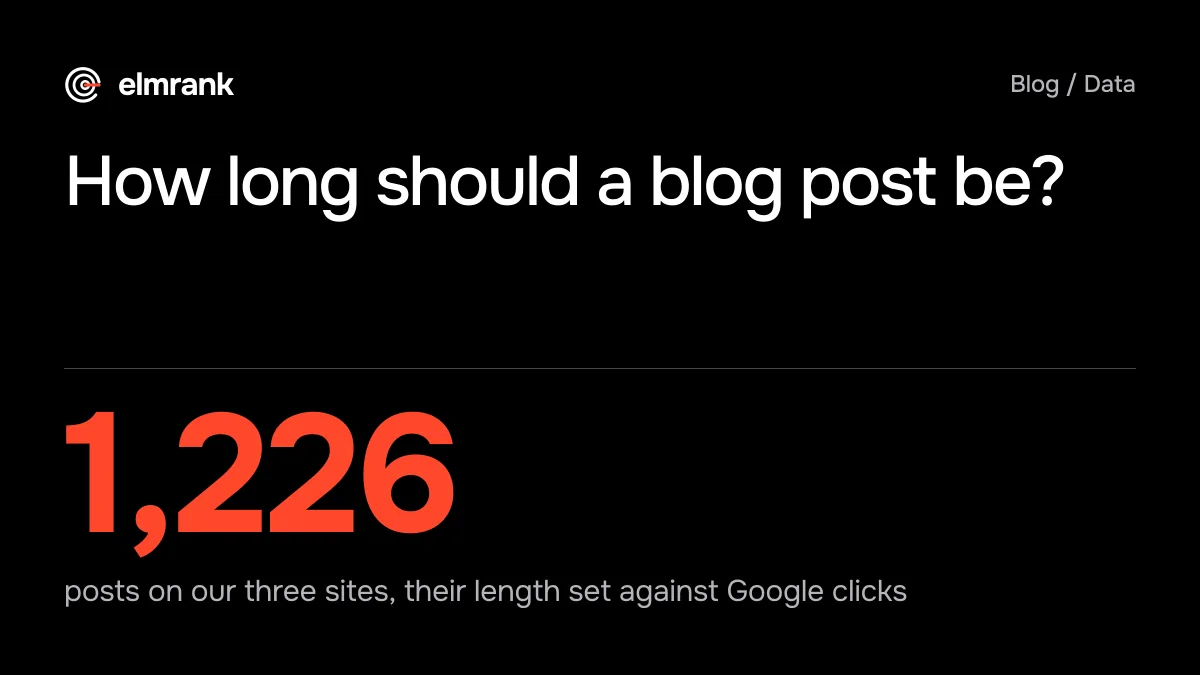
How long should a blog post be for SEO? Google has no preferred word count. We set 1,226 posts on our three sites against their clicks. What length did.

By Tyler Phan9 min readLast reviewed
Part of our guide to content optimization
On this page
Most answers to this question end in a number: 1,500 words, 2,000, 2,500. Google's own guidance doesn't give one. One of the questions it suggests you ask about your content is: "Are you writing to a particular word count because you've heard or read that Google has a preferred word count? (No, we don't.)"
We had a number anyway. Until October 13, 2026, the writing rules for the three content sites we run, about manhwa and anime, video games and trading card games, said: "Target 2 500-3 000 words for best SEO performance regardless of type." So on October 22 we counted the words in every post on the three sites and set each count against the clicks the post got from Google over four weeks. On one site, longer posts got more clicks. On the other two they got slightly fewer.
What Google and the length studies say
Google's guidance doesn't name a number. The closest it comes is a question about scope: "Does the content provide a substantial, complete, or comprehensive description of the topic?" That asks what the page covers, and a short page can cover a narrow topic completely.
The numbers people quote come from studies of what ranks. Backlinko's analysis of 11.8 million Google results, first published in 2016 and updated since, found that "The average Google first page result contains 1,447 words," and that "word count was evenly distributed among the top 10 results." We read the second finding as the more useful one: the first result wasn't typically longer than the tenth. Yoast's SEO plugin shows a red light on a post under 300 words, and Yoast says these minimums "act as a quality floor" and that word count "is not a direct ranking factor."
An average of what ranks describes those pages. It can't tell you how long yours should be, and it can't separate length from what comes with it, such as how big the topic is. That's what we wanted to look at on our own sites.
How we measured it
Each of our three sites keeps its posts as text files in a code repository, so we counted words there rather than on the live page. The count covers the post body and its FAQ, which is what a reader sees in the post itself, and leaves out menus, sidebars, related-post lists and footers. As a check, we also counted the words in the main column of each live page, which holds some of the site's own labels as well: the medians there were 2,137, 2,402 and 2,152 words, against 2,034, 2,262 and 2,157 from the files. We matched every post to its address in the site's sitemap and joined it with Search Console's clicks for that page from September 22 to October 19, 2026, counting the www and non-www addresses of a page as one page.
We kept only posts published by August 22, so that each had been live for at least a month before the four weeks began. A post from last week has had no time to get clicks at any length.
| Site | Posts compared | Typical length | Clicks in four weeks |
|---|---|---|---|
| Manhwa and anime | 352 | 1,222 to 3,478 words | 15,523 |
| Game news | 659 | 1,400 to 3,185 words | 12,669 |
| Card game | 215 | 1,118 to 3,177 words | 1,990 |
Posts published by August 22, 2026, with Search Console web clicks per page from September 22 to October 19, 2026. Typical length is the middle 80% of posts; the medians were 2,034, 2,262 and 2,157 words. Words in the body and FAQ, counted from each site's repository on October 22.
Every one of these posts was added to its site while the 2,500 to 3,000 word target was in the rules, next to minimums by kind of post (1,500 words for a guide, 350 for a news item). Most posts didn't reach the target: 427 of the 1,226, or 35%, had 2,500 words or more. That makes this a check on our own rule as well.
What length did on our three sites
| Words | Manhwa and anime | Game news | Card game |
|---|---|---|---|
| Under 1,500 | 15.5 (80) | 0 (83) | 8 (64) |
| 1,500 to 1,999 | 11 (91) | 2 (159) | 3 (29) |
| 2,000 to 2,499 | 1 (87) | 4 (162) | 1 (44) |
| 2,500 to 2,999 | 4 (43) | 7.5 (156) | 2 (44) |
| 3,000 or more | 8 (51) | 11 (99) | 3.5 (34) |
On the game news site, the median post got more clicks in every longer band, from none under 1,500 words to 11 at 3,000 or more. Ranked by length and by clicks, the two orders agreed with a correlation of 0.38, which across 659 posts is very unlikely to be chance. Posts that reached the 2,500 words our old rule started at, or went past them, had a median of 9 clicks there, against 2 for the shorter ones. That cut comes from the old rule, and we used the same one on all three sites.
The other two sites went the opposite way, more weakly. On the manhwa site the shortest posts had the highest median, and the correlation was −0.13; on the card game site it was −0.18. Both are small. Taken one at a time, each clears the usual bar for ruling out chance (p of about 0.01 to 0.02). But we ran the same test on three sites, and posts written in the same batch about the same series don't vary independently of each other, so we treat both as only weakly distinguishable from chance. Posts at 2,500 words or more had a lower median than the shorter ones on both sites (5 clicks against 7, and 2 against 4), a gap small enough to be chance. Pool all three sites and you get a weak positive correlation of 0.12, a number that describes none of them.
The manhwa column has one more twist. Its 51 posts of 3,000 words or more had a median of only 8 clicks, yet together they took 62% of the clicks to the 352 posts. A few of them got very many, and that's where the next section starts.
Why the most-clicked posts were long
We took the tenth of posts with the most clicks on each site and compared their length with the rest.
- Manhwa and anime
- 3,484 vs 1,956
- median words, top 35 posts vs the other 317; the 35 had 75% of the clicks
- Game news
- 2,647 vs 2,190
- top 66 vs the other 593; the 66 had 67% of the clicks
- Card game
- 2,603 vs 2,104
- top 22 vs the other 193; with 22 posts the gap could be chance
On the manhwa site, 31 of the top 35 were recommendation lists: the best series of a genre or kind, or series like a given title. A list like that covers many series with a few paragraphs each, so it runs long. On the game news site, 63 of the top 66 were guides, eight of them the site's hub guides to a single game. A builds guide or a walkthrough has a lot to explain. On the card game site, 18 of the top 22 were guides, most of them deck or color guides, and the length gap was small enough to be chance (p = 0.09).
So the long posts that did best covered big topics. Within one kind of post, length didn't point the same way across sites. Take guides: on the game news site, longer guides got more clicks (correlation 0.23 across 410 guides), and on the other two they got fewer (−0.45 across 94 on the manhwa site, −0.19 across 122 on the card game site). Other kinds of post were mixed. For features the correlation ran from 0.09 on the manhwa site to −0.45 on the card game site, and for reviews from 0.06 on the game news site to −0.28 on the manhwa site. We can't tell from this data whether the long manhwa guides were padded or about series fewer people search for. Either way, the extra words didn't come with extra clicks there.
Our reading is that what made the winners long and what made them popular was the same thing, the size of the topic. That's an interpretation of correlations. We didn't lengthen or shorten any post to see what would happen.
These numbers come from three entertainment sites that publish a lot and write every post under the same rules, and no business site's posts are among them. The shortest post we compared had 533 words and only 12 of the 1,226 had 5,000 or more, so the data says nothing about a 300-word post and little about a very long one. It also covers only posts we could match to one address in each site's sitemap. Of the 1,889 post files in the three repositories, 74 had no such match, scheduled or redirected posts for example, and we left them out.
The posts that got no clicks
If length were what earned clicks, you'd expect the posts that got none to be the short ones. On our sites they weren't, consistently. On the manhwa site, the 72 posts with no clicks were longer than the rest (median 2,204 words against 1,894). On the game news site, the 160 with no clicks were shorter (1,917 against 2,414). On the card game site, the 46 with no clicks were the same length as the rest (2,157 against 2,150).
Length didn't explain indexing on our sites either. Among the pages Google had crawled and left out of its index on October 20, the five full articles had 2,100 to 3,050 words, about as long as the indexed articles we sampled on the same sites; crawled, currently not indexed has the list.
How we decide how long a post should be
- 1List the questionsQueries similar pages already get in Search Console, the top results' headings, People also ask
- 2Answer each one onceThe direct answer near the top, then one section per question
- 3Cut what repeatsLong intros, recaps, definitions the reader already knows
- 4Check after four weeksClicks and queries for the page in Search Console
On October 13 we took the target out of all three sites' rules. They now keep minimums only, 300 words for a news item, and the card game site's version says: "Length follows the value of the story; stop when the reader has the answer." It's too early to measure what that changed, and the numbers above come from posts written before it.
We start from the questions a searcher brings to the page. Search Console shows which queries your pages already appear for (our long-tail keywords post looks at them in detail), and the headings of the top results show what the pages Google ranks for the topic cover. Each question gets an answer, the main one first. When the list is answered, the post is done.
For a narrow question, that can be a few hundred words. For a list of 20 series or a guide to every class in a game, it's several thousand, and cutting it to a target would leave questions unanswered. When you study the pages that rank, compare what they cover with what yours covers. Yoast puts it this way: "Your goal is not to match their word count, but to match or exceed their usefulness."
Four weeks after a post goes up, look at it by page in Search Console. If it shows for queries it doesn't answer, add a section for them. If it barely shows at all, we wouldn't start by adding words: on our sites, the posts with no clicks weren't consistently the short ones. Our Search Console guide covers what we'd check next.
The content plan in our service
In our SEO content service, the content plan starts from what your customers search for and is updated as the numbers come in, and each article opens with a direct answer to the search. The plan is $500 for the first month and $300 a month after, for up to 30 articles a month depending on your niche. To see what we'd fix first on your site, send it to us.
Questions
Does word count affect SEO?
Not as a number Google looks for. Google's guidance asks whether you're writing to a word count because you heard Google prefers one, and answers "No, we don't." On our three content sites, longer posts got more clicks on one site and slightly fewer on the other two, so length on its own told us nothing we could plan with.
How many words should a blog post be in 2026?
As many as the question needs. Eight in ten of our 1,226 posts ran between about 1,300 and 3,300 words, and the median on each site was 2,000 to 2,300. The posts with the most clicks on our two larger sites were longer than the rest, and they covered more: lists of many series, and game guides with many parts.
Is 300 words too short for a blog post?
For a question with a short answer, it can be enough. Yoast's plugin shows a red light on a post under 300 words, and Yoast calls its minimums "a quality floor". None of our posts was that short: the shortest of the 1,226 we compared had 533 words.
How we know this
Written by Tyler Phan. Every source below was read on the date shown; the page was last reviewed on Oct 31, 2026.
- Google Search Central, Creating helpful, reliable, people-first content, accessed Oct 22, 2026
- Backlinko, We Analyzed 11.8 Million Google Search Results, accessed Oct 22, 2026
- Yoast, Word count and SEO: how long should an article or page be?, accessed Oct 22, 2026
- Elmrank, word counts of every post on our three content sites against Search Console clicks by page (September 22 to October 19, 2026) and the sites' writing rules, checked October 22, 2026, accessed Oct 22, 2026
Send us your site.
We reply within 12 hours with what we'd fix first. Then we run it for you, technical SEO and content: $500 for the first month, then $300 a month for up to 30 articles. You don't need any technical knowledge, and you can cancel any time.