How to Update Old Blog Posts: What 597 of Our Edits Did
How to update old blog posts for SEO, from 597 edits on our three sites: edited posts did no better than posts we left alone, measured the same way.

By Tyler Phan9 min readLast reviewed
Part of our guide to content optimization
On this page
In September 2026 someone asked r/SEO what to do with hundreds of old blog posts. One of the first replies, from u/deedee_QT, said to update the ones that still get traffic: "Refresh the stats, rewrite the weak sections, fix the intent if it's drifted, and republish with a new date. This is usually the highest ROI SEO work you can do, since Google already trusts those URLs." It's a common habit: in Orbit Media's yearly survey of content marketers, the share updating older articles "hit a high of 73%" in its 2020 to 2022 results.
We do it too. On the three content sites we run, about manhwa and anime, video games and trading card games, 1,139 of the 1,266 posts that were at least eight weeks old had been edited after their first four weeks, by at least 100 words or with a new title or meta description. Each site keeps its posts in a code repository, so every edit has a date. We set 597 of those edits against Search Console clicks for the post in the four weeks before and after, compared each one with similar posts on the same site, and then ran the same measurement on the posts we had left alone.
What Google says about updating old content
Two of the questions Google suggests you ask about your own content are about updates done for search: "Are you changing the date of pages to make them seem fresh when the content has not substantially changed?" and "Are you adding a lot of new content or removing a lot of older content primarily because you believe it will help your search rankings overall by somehow making your site seem 'fresh?' (No, it won't)".
Freshness does count for some searches. Google's guide to its ranking systems describes "query deserves freshness" systems "designed to show fresher content for queries where it would be expected", and gives the example of a movie that has just come out, where searchers "probably want recent reviews rather than older articles from when production began." A post about something that changes, such as a release, a price or a game's current patch, has a reason to be updated that a post about a settled question doesn't.
On dates, Google's guidance says they "must describe the publication or update date of the page," and that its systems look at several factors "to determine our best estimate of when a page was published or significantly updated." After a real change, you can ask Google to recrawl the page, but "Crawling can take anywhere from a few days to a few weeks."
The same r/SEO thread has the other view in two lines. Another commenter had said that old posts which don't compete with newer ones should be updated "to be current for the search engines to crawl and index them", and u/WebLinkr answered: "1) they probably are indexed 2) content doesnt need to be 'current' to be ranked or indexed".
How we measured 597 edits
For every post on the three sites, we went through the repository's history and measured each change to the post's text: words added plus words removed in the body and FAQ, so moving a block or swapping punctuation counts as no change. We counted an edit when 100 or more words changed or the title or meta description was new, and treated all of a day's commits to one post as one edit.
To measure an edit, we needed it to stand alone. We kept edits made at least four weeks after the post was published, with four weeks of Search Console data after them (so on or before September 23, 2026), and with no other edit of that size to the same post within four weeks either side. That left 597 edits from May 26 to September 23, made when the post was a median of 72 days old. Going by the commit messages, 455 of them were freshness audits or fact fixes. Most of the others added sections, structured data or links, or changed titles.
A site's clicks move for reasons that have nothing to do with one post, such as players leaving a game or a change at Google. So for each edit we took the posts on the same site published within 14 days of the edited one that hadn't had an edit of that size in the same eight weeks, and saw how their clicks changed from the four weeks before the edit to the four weeks after. If they lost 20%, we expected the edited post to lose 20% too. An edit came out ahead when the post did better than that.
| Site | Edits measured | With enough clicks to compare | Ahead of similar posts | Clicks after the edit (expected) |
|---|---|---|---|---|
| Manhwa and anime | 163 | 48 | 15 | 9,652 (10,291) |
| Game news | 339 | 142 | 55 | 6,957 (8,470) |
| Card game | 95 | 0 | not measured | not measured |
Search Console web clicks by page and day, final data. "Enough clicks" means at least 10 in the four weeks before the edit, and at least five similar posts with 50 clicks between them.
The card game site drops out because its posts get few clicks each. Only 15 of its 95 edits were to posts with 10 or more clicks in the four weeks before, and none of those had enough clicks among similar posts to compare with.
That comparison has a catch, which showed up when we ran it on posts we hadn't edited. Asking for 10 clicks in the four weeks before picks posts that had a good month, and a post with a good month often has a weaker one next. The comparison posts are added together, so they swing less. To get a fair bar, we measured the posts we left alone in the same way: every week from May 26 to September 22, each post at least four weeks old, with no edit of that size within four weeks either side and 10 or more clicks in the four weeks before, counted once against its own comparison posts. On the manhwa and game news sites that gave 1,302 weeks from 334 posts. That is what the edits have to beat, not a coin toss.
What happened after the edits
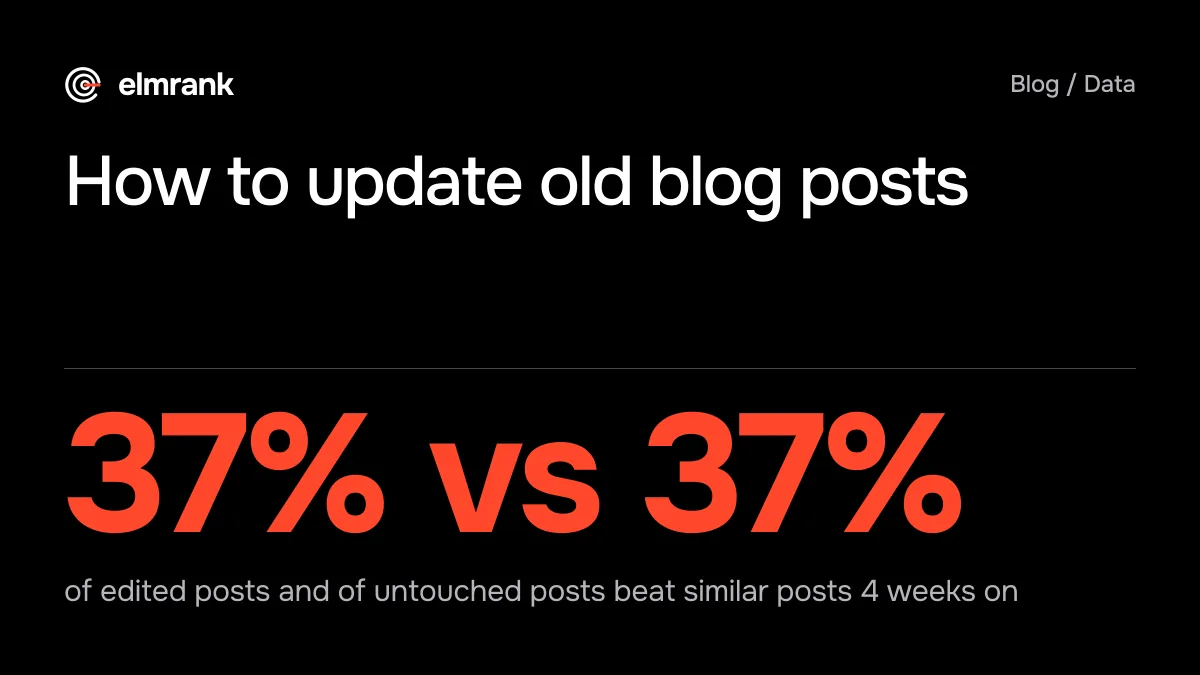
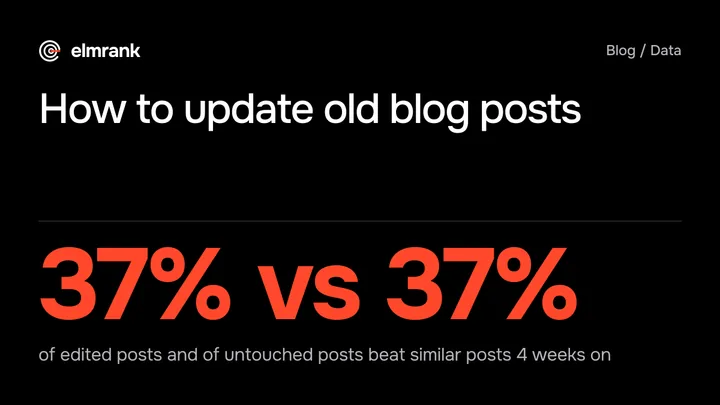
Across the two sites we could measure, 70 of 190 edited posts (37%) did better than their comparison posts in the four weeks after the edit. Among the posts we left alone, 484 of 1,302 (37%) did. The edited posts got 16,609 clicks where their comparison posts predicted 18,761, 11% fewer; the untouched posts got 58,897 where 67,613 were predicted, 13% fewer. Impressions said the same: 171 of 415 edited posts came out ahead (41%), against 1,234 of 2,940 untouched (42%). A difference that small could easily be chance, all the more because the edits came in batches: the 190 fell on 41 site-days (29 calendar days), with up to 31 at one site on a single day.
Leaving out the edits whose commit message called them corrections doesn't change that: 61 of the other 152 edits with enough clicks came out ahead (40%).
| Posts | Count | Ahead of similar posts | Clicks after (expected) |
|---|---|---|---|
| New title or description, under 100 words changed | 15 | 4 | 2,387 (2,415) |
| 100 to 499 words changed | 114 | 47 | 12,344 (14,413) |
| 500 words or more changed | 61 | 19 | 1,878 (1,933) |
| All edits | 190 | 70 | 16,609 (18,761) |
| Left alone (weeks) | 1,302 | 484 | 58,897 (67,613) |
By size, edits of 100 to 499 words came out about where untouched posts did: 47 of 114 ahead (41%). The rewrites of 500 words or more did worse post by post, 19 of 61 ahead (31%) against 37% of untouched posts (p = 0.42), with 31 of the 61 at least a quarter below what was expected, while a few large gains kept their total close to the prediction. That gap could be chance (p = 0.25 against the smaller edits). Title and description changes on their own were too few to say anything about: 15 edits, 4 ahead. Our CTR post covers what a title can and can't do for clicks at a given position.
Posts picked like ours slip anyway
The posts we chose to edit weren't a random sample, so we checked what each one was doing before its edit. For 127 edits we could compare the four weeks before the edit with the four weeks before that, and 42 of those posts (33%) had done better than their comparison posts going in. Untouched posts picked the same way slipped too: 287 of 742 (39%) had done better. Ours slipped a little more, by a margin that could be chance (p = 0.24).
We also checked whether each edit changed the post's direction. For the 101 edits we could follow through both periods, the post's standing against its comparison posts improved after 49 (49%). For untouched posts over the same eight weeks it improved in 235 of 574 cases (41%). That leans toward the edits, but it could be chance (p = 0.16). The big rewrites got worse after 23 of 37, about as often as untouched posts did.
Our reading is that edits like ours, mostly fixes to facts and dates, didn't move a post's clicks either way in the next four weeks, and whatever the post was already doing carried on. That's an inference from comparisons, not an experiment: we didn't hold back a random half of the posts we meant to edit. Two other limits matter. These are three entertainment sites, and a site in another field may see something different. And on all three we edit so often that only 597 of 3,231 edits after a post's first four weeks stood far enough from the next one to measure.
How we'd update an old post
- 1Find out why it's slippingImpressions, position and queries by page in Search Console
- 2Fix what's wrong or missingFacts, numbers, dates, a question the post doesn't answer yet
- 3Date it honestlyChange the shown date only when a reader would see a difference
- 4Ask for a recrawlURL Inspection, Request Indexing, once per real change
- 5Compare after four weeksAgainst similar pages you didn't touch in those weeks
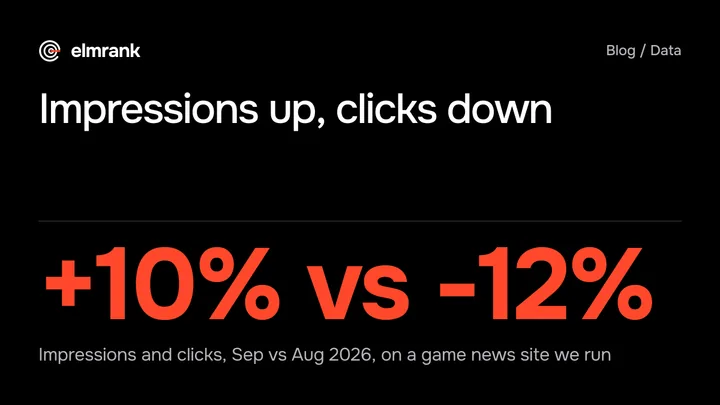
Start with the reason the post is slipping, because that decides whether editing it can help. In Search Console's Performance report, filter to the post's address and compare the last four weeks with the four before. If impressions fell while the position held, fewer people may be searching for it, and a rewrite won't change that; impressions up, clicks down goes through how to tell the cases apart. If a newer page of yours is taking the same searches, merging may fit better than updating, which keyword cannibalization covers.
Then fix what a reader would find wrong or missing: a number that has changed, a step that no longer works, a question people search that the post doesn't answer. That's the kind of change worth a new "last updated" date. A reworded intro or a moved section isn't.
After the change, request indexing for the page in URL Inspection, once. Google says asking again for the same URL "won't get it crawled any faster."
Four weeks later, compare the page with pages you left alone. A post that lost 10% while similar posts lost 30% did well, and one that gained 5% while the rest of the site gained 25% didn't. The page you picked may also have just had a good month, so a dip afterwards doesn't prove the edit hurt: on our sites, untouched posts with 10 or more clicks in the four weeks before failed to beat their comparison posts 63% of the time. Keep a dated log of each change so you can line it up with the report later. Our Search Console guide shows where these numbers live.
Where this sits in our plan
In our SEO content service, the content plan starts from what your customers search for and is updated as the numbers come in, and each article opens with a direct answer to the search. The plan is $500 for the first month and $300 a month after, for up to 30 articles a month depending on your niche. To see what we'd fix first on your site, send it to us: the list is free, and we reply within 12 hours.
Questions
Does updating old content help SEO?
Not by itself, on our sites. We measured 190 edits to old posts against similar posts on the same site, then ran the same measurement on posts we left alone: 37% of each group did better than its comparison posts over the next four weeks. Update a post because something in it is wrong, out of date or missing for the reader, and check afterwards whether it helped.
Should I change the date when I update a blog post?
Only when the content changed in a way a reader would notice. One of the questions Google suggests you ask about your content is: "Are you changing the date of pages to make them seem fresh when the content has not substantially changed?" Google's guidance on dates says they must describe the publication or update date of the page.
How long should I wait before judging an update?
We used four weeks. Google says crawling after a request "can take anywhere from a few days to a few weeks", and in October 2026 Googlebot came back to a typical page on our three sites every 1.8 to 4 days. Compare the four weeks after the edit with the four weeks before, against similar pages you didn't change in that time.
How we know this
Written by Tyler Phan. Every source below was read on the date shown; the page was last reviewed on Nov 2, 2026.
- Google Search Central, Creating helpful, reliable, people-first content, accessed Oct 24, 2026
- Google Search Central, A guide to Google Search ranking systems (freshness systems), accessed Oct 24, 2026
- Google Search Central, Influencing your byline dates in Google Search, accessed Oct 24, 2026
- Google Search Central, Ask Google to recrawl your URLs, accessed Oct 24, 2026
- r/SEO, Old Blog Posts -- What do you do with them? (September 2026), accessed Oct 24, 2026
- Orbit Media, Blogging Statistics 2026: What 1,042 Content Marketers Told Us About What Works, accessed Oct 24, 2026
- Elmrank, every edit to the posts on our three content sites from their repositories' history, set against Search Console clicks by page and day (to October 21, 2026), with the same measurement on posts we left alone, checked October 24, 2026, accessed Oct 24, 2026
Send us your site.
We reply within 12 hours with what we'd fix first. Then we run it for you, technical SEO and content: $500 for the first month, then $300 a month for up to 30 articles. You don't need any technical knowledge, and you can cancel any time.