Page Indexing Report: What Each Status Meant on Our Sites
What the statuses in Search Console's Page indexing report mean and which need a fix, from URL Inspection of 765 URLs on three sites we run.

By Tyler Phan11 min readLast reviewed
Part of our guide to technical SEO
On this page
Search Console's Page indexing report splits the URLs Google knows on your site into indexed and not indexed, and gives every URL in the second group a reason. Many of those reasons aren't errors. Google's help says it plainly: "Non-indexed URLs can be fine. Read and understand the specific reason for each non-indexed URL to confirm that the page shouldn't be indexed."
To see what the statuses meant in practice, on October 23, 2026 we put 765 URLs from three sites we run through URL Inspection, the tool Google points to for the status of a single page. That covered every URL in their sitemaps plus 317 addresses outside them that Google could have come across. The three sites are elmrank.com and two content sites that went live in October 2026, one about Pokémon cards and one about romantasy books.
Where the statuses come from
The report has two groups, indexed and not indexed, and the second is broken down by reason. Google's guide to it asks one question about that group: "Are the gray (not indexed) URLs not indexed for good reasons? It's fine for a URL not to be indexed for the right reasons—for example, an expected robots.txt rule on your site, a noindex tag on the page, a duplicate URL, or a 404 for a page that you've removed and have no replacement for."
The report shows sample URLs, not all of them: the list "is limited to 1,000 items, and isn't guaranteed to show all URLs in a given status." For one URL, use URL Inspection. Its help adds the detail that matters most here: "All information shown in this tool is derived from this last crawled version."
The report has no API, but URL Inspection does, and it returns the status as text, for example "Page with redirect." We inspected three groups of URLs on each site:
- every URL in the sitemap;
- every link on those pages to the same site that isn't in the sitemap (feeds and calendar files left out);
- the
http://and the www or non-www form of the home page and three other pages.
We also added the few pages with Search Console impressions in the past 16 months that weren't in the sitemap, and fetched every URL ourselves the same day to compare what Google had recorded with what the page said then.
| Site | Sitemap URLs | Indexed | Checked outside the sitemap |
|---|---|---|---|
| elmrank.com | 68 | 66 | 24 |
| Pokémon cards | 142 | 134 | 91 |
| Romantasy books | 238 | 233 | 202 |
URL Inspection API, October 23, 2026, 12:19 to 12:31 (UTC+7). "Indexed" is "Submitted and indexed".
The statuses we saw
| Status | URLs | In our sitemaps | Needs a fix? |
|---|---|---|---|
| Submitted and indexed | 458 | 433 | No |
| URL is unknown to Google | 179 | 5 | Only for a page you want found |
| Excluded by 'noindex' tag | 100 | 0 | Only if the page should be in search |
| Alternate page with proper canonical tag | 13 | 0 | Only if the canonical is wrong |
| Discovered - currently not indexed | 10 | 10 | Wait, then check links and server |
| Page with redirect | 5 | 0 | Only if you link to it or list it |
765 URLs on three sites, October 23, 2026. The 25 indexed URLs outside the sitemaps are pages we haven't listed there, mostly tag pages; the URL Inspection API gave them the same "Submitted and indexed" label, and we don't know why.
The three statuses that sound like problems, noindex, alternate and redirect, were the ones we had asked for. None of them touched a sitemap URL. The sections below take them one at a time, then the ones Google simply hadn't got to yet.
Excluded by 'noindex' tag
Google's help puts it this way: "When Google tried to index the page it encountered a 'noindex' directive and therefore did not index it. If you do not want this page indexed, congratulations!"
All 100 of ours were pages we noindex on purpose:
- 53 tag pages with a single post. Both content sites keep a tag page out of search until it has enough posts to be worth a visit: two on the card site, three on the book site.
- 41 book pages on the book site that we keep out of search until their details are sourced.
- Two search pages, one second page of the blog list, and three hub pages.
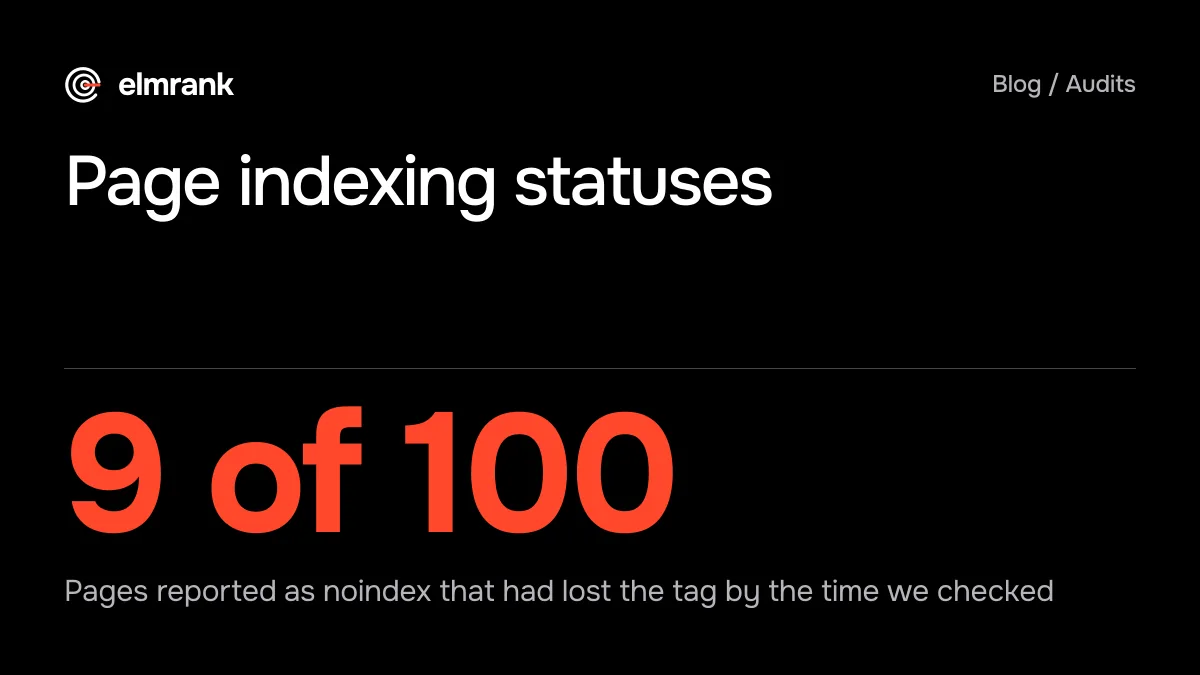
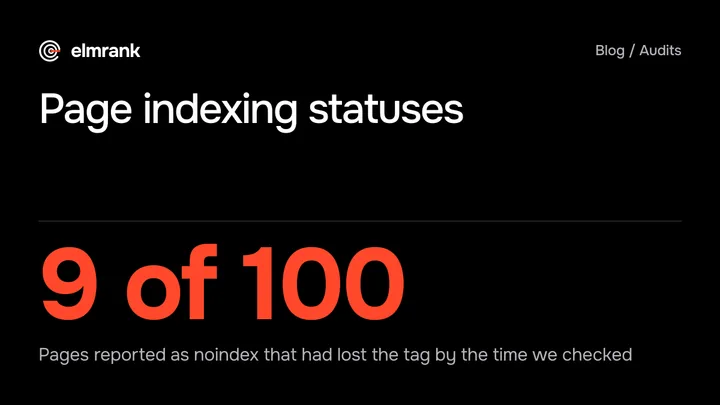
When we fetched the 100 pages ourselves, 9 no longer had the tag: eight tag pages on the card site and one on the book site. Every one of the 53 tag pages had a single post when Google last crawled it, between October 9 and October 22 (UTC). Since then, those nine had picked up enough posts to cross their site's line, so the template had dropped the noindex. Search Console was still reporting what it saw on that last visit.
If a page you want in search is here, remove the noindex, whether it's a <meta name="robots"> tag or an X-Robots-Tag header, and make sure robots.txt doesn't block the page. Google needs to fetch it to see the change: "For the noindex rule to be effective, the page or resource must not be blocked by a robots.txt file." Then run Test live URL in URL Inspection and request indexing.
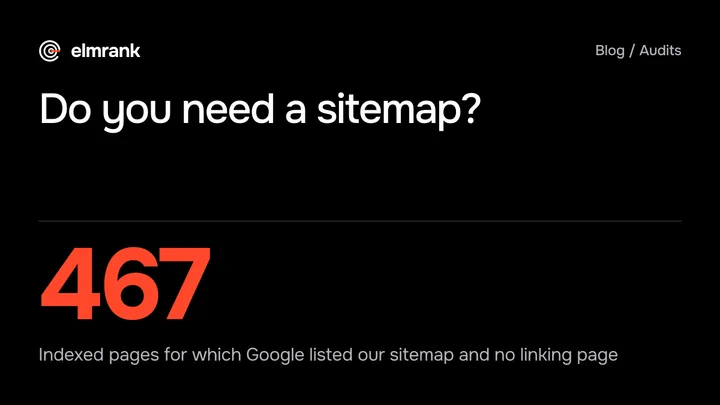
A noindexed page also shouldn't be in your sitemap. None of ours were, but the report can blur that check too: on the manhwa and card game sites we also run, Google reported a noindex on 43 sitemap URLs on October 20, and none had the tag when we fetched them two days later. Do you need a sitemap has that story.
Alternate page with proper canonical tag
Google's help describes this status narrowly: "This page is marked as an alternate of another page (that is, an AMP page with a desktop canonical, or a mobile version of a desktop canonical, or the desktop version of a mobile canonical). This page correctly points to the canonical page, which is indexed, so there is nothing you need to do."
SEOTesting's guide to the status reads it more broadly: "Product variants, filtered URLs, print pages, AMP, RSS, and language/region pages commonly trigger this status." That matches what we saw. None of our sites has AMP or a separate mobile site, and we still had 13. All of them were addresses with parameters whose canonical tag pointed at the same address without them:
- 11 on the card site: links to its pull-rate calculator with a set, a card or a pack count filled in;
- 2 on elmrank.com: links to our contact form that record which button was clicked (
/start?from=…).
In all 13, the canonical Google selected was the one the page declared. In URL Inspection, compare "User-declared canonical" with "Google-selected canonical"; if they match and the URL isn't a page you want in search on its own, the status is fine.
People who answer in Google's own help forum say the same. When a site owner asked how to fix this status in October 2025, dwsmart replied that "Usually, this is a sign of things working as they should, not a problem," and that "Often it's just down to things like tracking parameters, or trailing / not trailing slashes." Shortly after, OptimistPrime put it in two sentences: "It means URL A is not indexed because it has a canonical tag pointing to URL B which is indexed. This is not an error, nothing needs to be fixed."
Expect the count to grow without anything going wrong. Google knew 13 of the 53 parameter links on our pages; the other 40 were "URL is unknown to Google." As it crawls more of them, more will land in this group.
The status needs a fix when a page you want in search is in the list. That usually means a template gave it a canonical tag pointing somewhere else.
When Google keeps the page anyway
Google can turn a canonical tag down. Its canonical guide calls the tag "A strong signal that the specified URL should become canonical," and on four of our pages Google went the other way. Each declared another page as its canonical, and Google indexed it under its own address:
- two series pages on the book site, whose canonical points at the reading-order guide for that series;
- two second pages of author lists, one on each content site, whose canonical points at the first page.
All four were "Submitted and indexed," so in the report they sit with the indexed pages and nothing flags them. You only see the disagreement in URL Inspection, where "Google-selected canonical" is the page itself. In its notes on canonical problems, Google's help explains what that means: "If the Google-selected canonical is the tested page, then Google thinks that the tested page isn't similar to any other pages."
For the list pages, Google had a point, and its own pagination guide says so: "Don't use the first page of a paginated sequence as the canonical page. Instead, give each page its own canonical URL." Page 2 lists different posts from page 1. If you want a page out of search and it isn't a real copy of another one, a canonical tag won't do it; use a noindex.
Page with redirect
Google: "This is a non-canonical URL that redirects to another page. As such, this URL will not be indexed. The target URL of the redirect might or might not be indexed, depending on what Google thinks about that target URL."
We had five, all versions of a home page: the http:// address, and the www or non-www form, whichever the site doesn't use. We had inspected 24 such versions, for each site's home page and three other pages, and when we fetched them all 24 answered with one 301 to the right address. Google listed 5 of the 6 home page versions as "Page with redirect" and had never recorded the versions of the other pages: all 18 were "URL is unknown to Google."
So the list shows redirects Google has run into, usually old addresses and links that point at them. A permanent redirect also tells Google which address to keep: "the indexing pipeline uses the redirect as a signal that the redirect target should be canonical."
Fix it when the redirecting URL is one you're still pointing Google at: in your sitemap, in internal links, or as a canonical. None of our sitemap URLs redirected. On older sites the list fills up with renamed and merged pages; our orphan pages crawl found 190 redirecting addresses with impressions on an older card game site we run, and those are fine as long as each lands on the right page.
Discovered, not indexed, and unknown
Fifteen sitemap URLs weren't indexed yet, and none of them had an error.
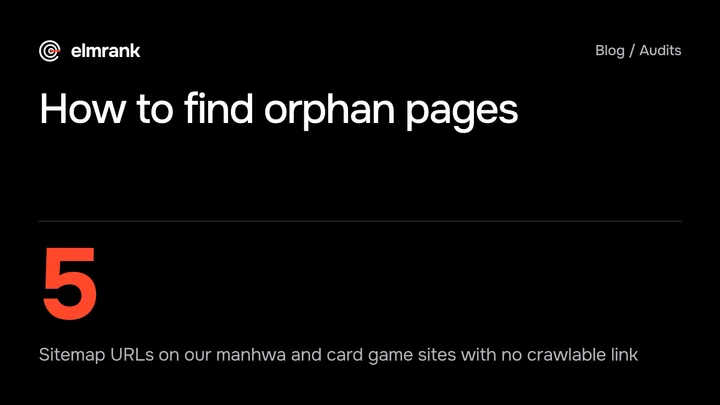
Five were "URL is unknown to Google": three posts published on the morning of our check, the comparison page we put live on elmrank.com the day before, and one tag page on the book site. Google just hadn't come across them yet.
Ten were "Discovered - currently not indexed", which Google explains this way: "Typically, Google wanted to crawl the URL but this was expected to overload the site; therefore Google rescheduled the crawl." Seven were the pages of one set on the card site, and the site links to each of them from 6 to 16 of its other sitemap pages, but Google listed no linking page for any of them. The other three were two posts and a category page on the book site. Discovered, currently not indexed covers what we'd do about pages that stay there.
"URL is unknown to Google" also covered 174 of the 317 addresses outside our sitemaps, including 97 book pages that carry a noindex. This status only exists in URL Inspection. The Page indexing report lists URLs Google knows, so a URL it hasn't recorded doesn't appear there under any reason.
A status is from the last crawl
The noindex pages show how this goes wrong. Nine of them had already lost the tag, and nothing in the report said so. If we had read the report alone, we'd have gone looking for a noindex that wasn't there.
Google's help gives the same answer for a report that still shows an error after a fix: "You might have fixed the error after the URL was last crawled by Google. Look at the crawl date for your URL." Before you change anything for a URL in the report:
- Open the URL in URL Inspection and read "Last crawl"
- Run Test live URL to see what Google gets from the page now
- If the live result is fine, request indexing for that page and move on
- If a whole group was fixed, use Validate fix in the report
Statuses we didn't see
Among these 765 URLs there was no soft 404, no 404, no server error, no robots.txt block, no duplicate status and no "Crawled - currently not indexed." The two content sites were about two weeks old and elmrank.com nine days old, with few removed or renamed pages, so that's what you'd expect. An older site, a shop with filters or a site that has moved will see more of them. In short:
- Soft 404: the page answers 200 but looks empty or like an error page. Google says "If the content suggests an error for Google Search, an empty page or an error message, Search Console will show a soft 404 error." Return a real 404 for pages that are gone, or put real content on the page.
- Not found (404): fine for a page you removed with no replacement. If the page moved, redirect it.
- Duplicate, Google chose different canonical than user: Google disagrees with your canonical tag. "A duplicate page must be similar to the canonical."
- Crawled - currently not indexed: Google fetched the page and left it out. Crawled, currently not indexed has what the pages on our other sites had in common.
Why your website isn't showing on Google has a table of the common ones with Google's wording for each.
How to work through the report
- 1Is it a page you want in search?Your sitemap is the list. If not, noindex, alternate, redirect and 404 are fine
- 2Read the last crawlThe status is what Google saw then, not what the page says now
- 3Fix by statusRemove a noindex, correct a canonical, link the final URL, return a real 404
- 4Test live, then validateTest live URL for one page, Validate fix for a group
Start with the reasons that touch pages you want found. On our sites, that was a short list: 15 sitemap URLs that Google hadn't crawled or recorded yet, and nothing with an error. The one thing we'd change came from URL Inspection, not the report: the two page-2 author lists whose canonical points at page 1, against Google's pagination advice. Google's own advice for the report: "Don't expect every URL on your site to be indexed."
Where this sits in our plan
Crawling and indexing are part of the first month's audit in our technical SEO service, and we make the fixes ourselves, in your code. The plan is $500 for the first month and $300 a month after. To see what we'd fix first on your site, send it to us: the list is free, and we reply within 12 hours. For the other stages, crawling and rendering, see our technical SEO guide.
Questions
What does "Alternate page with proper canonical tag" mean?
The URL has a canonical tag pointing at another page, and Google indexed that other page instead. Google's help describes it for AMP and separate mobile pages, but on our sites all 13 URLs with this status were addresses with parameters, such as a calculator link with a set and a card filled in, whose canonical pointed at the plain address. Google picked that same address in all 13. Nothing needs fixing unless an important page shows up here or Google picked a canonical you didn't intend.
Do I need to fix "Page with redirect"?
Not if the redirect is one you meant. Google's help says the URL "redirects to another page. As such, this URL will not be indexed." The page it redirects to can still be indexed. Fix it when a URL in your sitemap or your internal links redirects, when the redirect lands on the wrong page, or when a page you want in search shows up in the list.
Why does Search Console say noindex when my page has no noindex tag?
Because the status comes from Google's last crawl, not from the page today. Of 100 URLs Google reported as noindex on our sites, 9 were indexable when we fetched them: tag pages that got enough posts to lose the tag after Google's last visit. Check the last crawl date in URL Inspection, run Test live URL, and request indexing if the live page is fine.
How we know this
Written by Tyler Phan. Every source below was read on the date shown; the page was last reviewed on Nov 2, 2026.
- Search Console Help, Page indexing report, accessed Oct 23, 2026
- Search Console Help, URL Inspection tool, accessed Oct 23, 2026
- Google Search Central, How to specify a canonical URL with rel="canonical" and other methods (last updated July 10, 2026), accessed Oct 23, 2026
- Google Search Central, Redirects and Google Search (last updated April 14, 2026), accessed Oct 23, 2026
- Google Search Central, Block Search indexing with noindex, accessed Oct 23, 2026
- Google Search Central, How HTTP status codes, and network and DNS errors affect Google Search, accessed Oct 23, 2026
- Google for Developers, Search Console API reference (Search Analytics, Sitemaps, Sites, URL Inspection; no Page indexing report endpoint), accessed Oct 23, 2026
- Google Search Central, Pagination, incremental page loading, and their impact on Google Search (last updated December 10, 2025), accessed Oct 23, 2026
- Google Search Central Help Community, How can I fix the "Alternate page with proper canonical tag" issue in Search Console? (replies by OptimistPrime and dwsmart, October 13, 2025), accessed Oct 23, 2026
- SEOTesting, Alternate Page with Proper Canonical Tag: Fix Guide 2026, accessed Oct 23, 2026
- Elmrank, URL Inspection of every sitemap URL and 317 other addresses on three sites we run, with our own fetch of each (October 23, 2026), accessed Oct 23, 2026
Send us your site.
We reply within 12 hours with what we'd fix first. Then we run it for you, technical SEO and content: $500 for the first month, then $300 a month for up to 30 articles. You don't need any technical knowledge, and you can cancel any time.