Keyword Research for a New Website, With Free Data
Keyword research for a new website with free data: customer questions, autocomplete, the results page, then Search Console. What our first week showed.

By Tyler Phan8 min readLast reviewed
On this page
Keyword research for a new website starts with a handicap: there's no Search Console data of your own yet, and the searches that tools show big numbers for are the ones older sites already hold. We did it for elmrank.com in October 2026 with free sources only. We can also check the result against four domains we started this year: the three content sites we run, live since April and May, and elmrank.com, live since October 14. This guide is the order we work in, with what each step showed us.
- 1Customer questionsIn their words, grouped by topic
- 2AutocompleteGoogle and Bing, to see how people phrase them
- 3Volumes, if you canBing Webmaster Tools, Keyword Planner
- 4Who ranksForums and small sites, or the big publishers?
- 5Topics and pagesOne page per question, a guide per topic
- 6Search ConsoleAfter launch, what Google actually tries you for
Why a new site needs its own list
A new site has to win somewhere small first, and how small depends on the field. Here is the first week of each of our four domains:
| Site | Named searches, days 1 to 7 | Averaging a top-10 position | Share of named impressions in the top 10 |
|---|---|---|---|
| Card game site | 494 | 391 | 94% |
| Manhwa site | 149 | 86 | 52% |
| Game news site | 146 | 33 | 19% |
| elmrank.com | 336 | 7 | 0.6% |
Search Console, web search, final data, from each site's first day with impressions (elmrank.com: days 1 to 6, the final data available when we pulled it); named searches only. Details in is the Google sandbox real?.
The three content sites write about specific cards, series and games. elmrank.com writes about SEO, and several of the broad searches we checked for its plan were led by the large SEO tool companies and publishers. We think that's most of the gap, but it's our reading, not something Search Console measures. The practical point holds either way: in a crowded field, a new site's first list should be full of narrow questions.
Start from the questions customers ask
Google's SEO Starter Guide puts it simply: "Think about the words that a user might search for to find a piece of your content." Its example is that "some users might search for 'charcuterie', while others might search for 'cheese board'." It also says not to worry about catching every variant: "Google's language matching systems are sophisticated and can understand how your page relates to many queries, even if you don't explicitly use the exact terms in them."
So the first list is phrases, not keywords with numbers. For elmrank.com's plan we wrote 169 starting searches in seven groups: content, technical SEO, AI search, keyword research, measurement, site structure and new sites, plus 60 follow-ups once the first answers came back. For a business site the sources are closer to hand: the questions in your inbox, what sales calls keep coming back to, and the words customers use for your product rather than the ones on your price list.
Expand them with autocomplete
Autocomplete is the cheapest demand signal we know of. Google says its "autocomplete predictions reflect real searches that have been done on Google," and that it also weighs language, location, trending interest and your past searches. It adds that some predictions are "based on both real searches as well as word patterns found across the web." A suggestion tells you people type something like it. It doesn't tell you how many.
We ran all 229 starting searches through Google's and Bing's suggestion services on October 22, 2026. Google returned 10 suggestions, the most it gave for any search, for 111 of them, and none for 27. Bing returned up to 25 but matched more loosely. For "keyword research for new website," three of Google's four suggestions began with "keyword research for," while none of Bing's 14 contained the whole phrase; they included "what is keyword research" and "online keyword research tool." We read Google's count as the signal and Bing's as a second opinion.
Two limits to keep in mind. Our requests came from Vietnam with US English settings, and Google says location shapes the predictions. And the suggestion lists only show the start of the tail: as long-tail keywords shows, 57% to 83% of the clicks on our three content sites came from searches so rare that Search Console doesn't name them.
Add search volumes where you can
Autocomplete has no numbers. Two tools from the search engines themselves do:
- Bing Webmaster Tools, whose about page offers "free SEO/GEO tools," has a Keyword Research tool. Bing's help says it "gives you keyword ideas and stats of how frequently these keywords are searched for," with trends, the countries searching and the questions people ask, over up to the last six months. The volumes are Bing's, not Google's.
- Google's Keyword Planner gives Google volumes, but it lives in Google Ads, and Google's help says "You must complete your account setup by entering your billing information" to use even "Get ideas for new keywords." It also says "Keywords with very low search volumes" aren't discoverable or forecastable.
We didn't pull volumes for elmrank.com's plan. We ordered the topics by Google's suggestion counts, the results page, our first days of Search Console and the data we had of our own. If you do pull volumes, read a low number as small, not as nobody: the last step shows searches autocomplete didn't know that still brought us impressions.
Search each one and read who ranks
The results page shows something no volume does: who you'd be up against. For each candidate we read the first ten results and sort the search into one of three kinds. We treat searches led by Google's own documentation, forums and small blogs as open to a new site that has something of its own to add, searches led by the large SEO publishers and tool companies as a long wait, and mixed results as somewhere in between.
We read the top results for 12 searches this way on October 22, through a search API rather than Google itself, so the order differs from Google's. We used them for the kind of site that ranks, not for who is first. That check changed one decision. "How to use Google Search Console" had strong demand and a first page led by big publishers, so instead of hoping that one page would rank, we wrote it as a guide that links to narrower posts like average position in Search Console, where the first results were Google's help pages, forums and small sites.
Group the searches into topics and pages
Many searches on a list turn out to be variants of the same question. Give each question one page and let the variants land on it. On our three content sites, 19% to 27% of the searches Search Console named already brought up two or more of our pages, and keyword cannibalization shows when that's a problem worth fixing. Then group the pages into topics, each with one guide that links to the rest. On elmrank.com, the seven groups became the topics on our Learn page.
We also dropped a topic at this step. "Local SEO" and "Google Business Profile" both returned ten Google suggestions, but we run no local site and have no local data, so a guide from us would only repeat what others have written, whatever the demand.
After launch, let Search Console correct the list
Once Google indexes the first pages, Search Console shows the searches it tries you for. In elmrank.com's first week, October 14 to 20, Search Console named 390 searches, and 26 of them were about monthly SEO reports: "monthly seo report," "seo monthly reporting," "monthly seo dashboard" and the like. Those 26 had 447 of the 2,573 named impressions, 17%, for a subject we'd covered with one post and a sample report. That's why measurement went to the front of our plan.
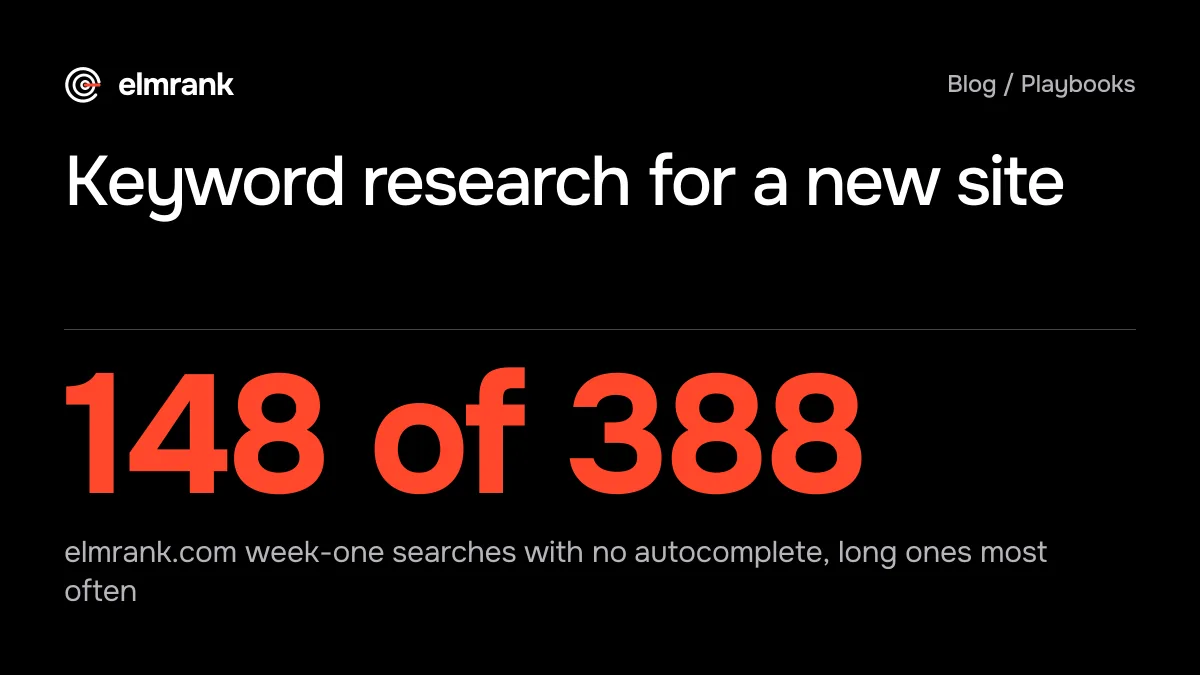
The same week showed what autocomplete leaves out. We typed each of the 390 searches into Google's suggestion service in full on October 23 (two were too long for it to accept):
| Of the 388 searches checked | Searches | Named impressions |
|---|---|---|
| Google suggested the search word for word | 154 | 1,429 |
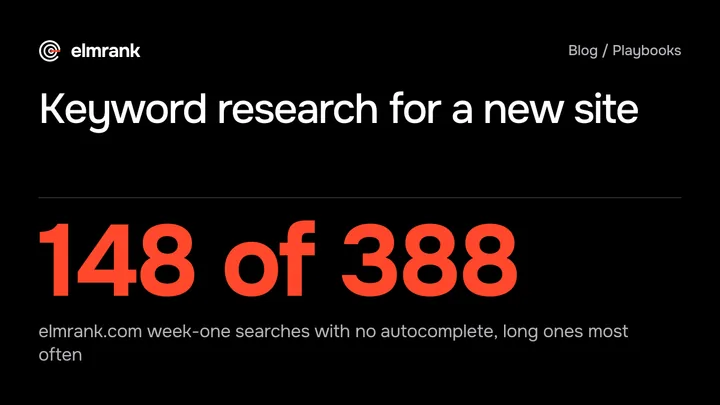
| Google gave no suggestion at all | 148 | 591 |
| Something in between (other suggestions only) | 86 | 551 |
elmrank.com, Search Console web search, final data, October 14 to 20, 2026; Google autocomplete with US English settings, run from Vietnam.
Part of this is length, not demand. In this sample of 388 searches, 17% of those with up to three words got no suggestion (21 of 123). With four or five words it was 48% (68 of 143), with six to eight 46% (50 of 108), and with nine or more 64% (9 of 14). Our reading is that autocomplete completes what people start to type, so it offers fewer long, specific searches whether or not people make them. Treat the 148 as searches autocomplete can't show you, not as proof that nobody else searches them.
One of the 148 was "how to read a monthly seo report," with 30 impressions in the week. Google's autocomplete didn't suggest it to us, so a list built from autocomplete alone would have missed it.
The searches where the new site did reach the first page were small. In its first six days, the seven searches that averaged a top-10 position were the names of three companies whose prices we list in our posts, a Reddit user we quote, two strings that began with a number, and one question, "what reports surface sudden traffic drops?". Each was seen one to four times.
Where this sits in our work
In our SEO content service, the content plan is built from what your customers search for in the first month and updated as the numbers come in, the same two passes as above. The plan is $500 for the first month and $300 a month after, for up to 30 articles a month depending on your niche. To see what we'd fix first on your site, send it to us: the list is free, and we reply within 12 hours.
Every guide in this series
- Long-Tail Keywords in SEO: What 28 Days of Our Data Show
Long-tail keywords are searches few people make. On three sites we run, 57% to 83% of clicks came from searches so rare Search Console won't name them.
- Keyword Cannibalization: What Our Search Console Data Shows
How to find keyword cannibalization in Search Console, and when it matters. On our sites one page got 90% of the clicks in 219 of 254 shared queries.
Questions
Can I do keyword research for a new website for free?
Yes. Google and Bing autocomplete show what people type, the results page shows who you'd be up against, and Bing Webmaster Tools has a Keyword Research tool with search volumes. Google's Keyword Planner also gives volumes, but Google says you must enter billing information in a Google Ads account to use it. Once the site is live, your own Search Console is the best free source, because it shows the searches Google actually tried you for.
Should a new website target high-volume keywords?
Not first. In elmrank.com's first six days, only 7 of the 336 searches Search Console named averaged a top-10 position, each seen one to four times, and its average position was around 70. Two of our content sites, writing about specific cards and series, had half or more of their first-week named impressions in the top 10. Start with specific questions where the first results are forums, help pages and small sites, and let the broad terms come later.
Are zero-volume keywords worth writing for?
Often, yes. A search can be too rare for a tool to show a number and still bring impressions. When we typed the searches that showed elmrank.com in its first week into Google, 148 of 388 got no autocomplete suggestion at all, and they made up 23% of its named impressions. Part of that is length, not demand: in this sample, 17% of the searches of up to three words got no suggestion, against 46% to 64% of the longer ones. One of the 148, how to read a monthly SEO report, had 30 impressions in that week.
How we know this
Written by Tyler Phan. Every source below was read on the date shown; the page was last reviewed on Nov 1, 2026.
- Google Search Central, SEO Starter Guide, accessed Oct 23, 2026
- Google Search Help, How Google autocomplete predictions work, accessed Oct 23, 2026
- Google Ads Help, Use Keyword Planner, accessed Oct 23, 2026
- Bing Webmaster Tools Help, Keyword Research, accessed Oct 23, 2026
- Bing Webmaster Tools, About, accessed Oct 23, 2026
- Elmrank, Google and Bing autocomplete for 229 seed searches (October 22, 2026) and for elmrank.com's Search Console queries, October 14 to 20 (October 23, 2026), accessed Oct 23, 2026
Send us your site.
We reply within 12 hours with what we'd fix first. Then we run it for you, technical SEO and content: $500 for the first month, then $300 a month for up to 30 articles. You don't need any technical knowledge, and you can cancel any time.